Why Did Cleaning Appliances Experience a Massive Surge Overseas This Black Friday?
Chinese cleaning appliance brands have exploded — and the growth is unmistakable.“From January 1 to November 20 this year, cleaning appliances on AliExpress have already grown by 85%,” revealed Ling Jing, the category manager for cleaning appliances on AliExpress, at a recent media briefing. This year’s Black Friday marked the first time that the cleaning appliance category experienced explosive growth on the platform.On the first day of the sale, multiple robot vacuum cleaners, floor scrubbers, and handheld vacuum models went out of stock in Europe and the Middle East. The platform had no choice but to urgently dispatch replenishment from overseas warehouses.Robot vacuum cleaners, floor scrubbers, pool cleaning robots, lawn mowers, even outdoor snow removal equipment — all are being reshaped by Chinese brands becoming the new backbone. This shift has already reached consensus across the global home appliance supply chain.Chinese cleaning appliances are good and cheap.Cleaning appliances have traditionally been a category tightly dependent on intelligent manufacturing and R&D capability, long dominated by international players such as iRobot and Dyson. But in the past three to five years, Chinese manufacturers have leveraged supply chain upgrades, material and process iteration, as well as breakthroughs in algorithms and navigation technology. In performance, price, and product matrix, they have fully caught up with — and in some cases surpassed — traditional leaders.Handheld vacuum cleaners provide a representative example on AliExpress.
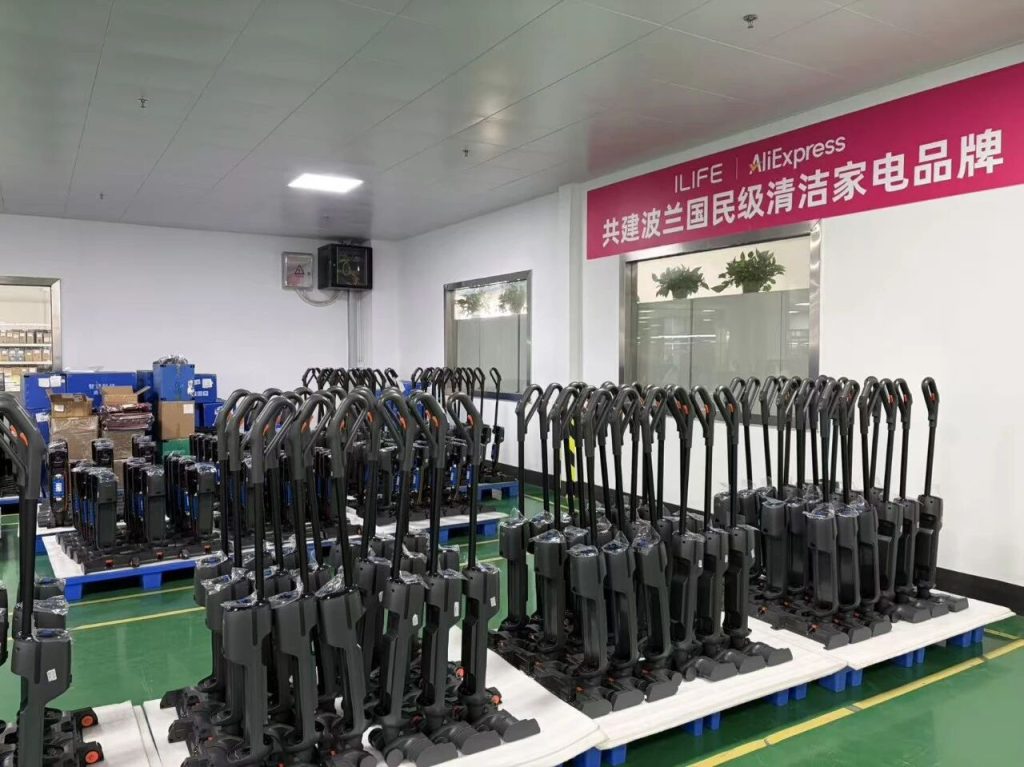
A series of videos from brand LARESAR show that in terms of build quality, functions, battery life, and user experience, their products can reach more than 80% of Dyson’s experience, while costing only 1/7 or even 1/8 of the price. With this advantage, the brand quickly gained user trust and “seeded” itself in consumer minds.ILIFE is another industry representative accelerating overseas expansion through AliExpress this year.In 2010, after seeing iRobot release its first-generation robot vacuum at CES in the United States, the ILIFE team entered the market. In 2012 they released their first robot vacuum and later cooperated with Deerma and ECOVACS. In 2014, after applying brushless motor technology to its products, ILIFE’s OEM business expanded rapidly; several leading domestic brands, including ECOVACS, became key partners.In its early years, ILIFE built its manufacturing infrastructure and technical foundation through OEM work, and thanks to strong integration of R&D, production, and sales, the company long operated a dual strategy of “OEM + own brand.”However, as competition intensified, the weaknesses of OEM became increasingly apparent: thinner margins, weaker bargaining power, and growth cycles heavily dependent on large customers’ procurement schedules and new product plans. The company found it difficult to truly hold the initiative.After years of technical accumulation, ILIFE completed its evolution from random navigation to inertial guidance, vision, laser navigation, and finally to sweep-mop integration and a full-featured unified product matrix — forming a solid basis for building a consumer-facing brand.
In October 2024, ILIFE shifted to focus entirely on its own brand and joined AliExpress’ “100-Billion Subsidy” and “Brand+” programs.In just one year, sales generated through AliExpress reached 40% of the group’s total revenue.In one year — it became a national brand.Poland became ILIFE’s first market where it could harvest “low-hanging fruit.” During this year’s Black Friday, ILIFE’s year-over-year sales on AliExpress grew by 130%, surpassing Amazon for the first time. Over the full year, total sales tripled; Poland entered the “10-million-dollar club” and reached a penetration rate of “1 ILIFE robot vacuum in every 10 households.”ILIFE’s rapid growth in Poland would not have been possible without the platform’s support.Back in 2016, ILIFE chose to treat Amazon as its main battlefield while also deeply cultivating the European market on AliExpress. In CEO Miao Qunyi’s view, it was better to fully master existing channels than to open new ones and relearn all the rules.European marketplaces have stable growth and align well with the price structure of cleaning appliances — one of the early reasons ILIFE bet on AliExpress.Robot vacuum cleaners are a classic category where product capability is dictated by usage scenarios. When users say “it got stuck and can’t get home,” this may reflect dozens of underlying causes: table legs, thick carpets, dark flooring triggering cliff sensors, etc. Without seeing the scene, brands can only guess — and guessing wrong means long iteration cycles.By contrast, AliExpress offers instant communication channels.
Users can upload photos directly; ILIFE can replicate scenarios on-site, buy the same carpets used by customers, test repeatedly, and adjust torque, ground clearance, or optical algorithms accordingly.For cleaning appliances — where micro-optimizations determine product competitiveness — this feedback speed is a real efficiency advantage.ILIFE previously had its own warehouse in Poland, but warehouses mainly solve logistics, not user insight. This year, the platform invested more heavily in brand building, and ILIFE matched that commitment.Both sides upgraded from a simple brand overseas project to the “Super Brand Program,” and then to “Brand+.” The platform connected brand exposure, campaign resources, advertising capability, and offline activations into one chain. ILIFE built AliExpress-exclusive product lines and treated Europe as its brand pilot market.During Black Friday, AliExpress ran pop-up and offline events in Poland. ILIFE staff joined and completed roughly 700 user interviews in Warsaw, directly learning user scenarios and preferences for robot vacuums and handheld vacuum cleaners.The platform also shared research results and retail store insights from different countries to help brands decide which products to prioritize in each market — reducing trial-and-error costs.Poland’s explosive growth appears at first to be the rapid rise of a brand in a foreign market. In essence, it is the result of ILIFE linking manufacturing capability, iteration efficiency, and localized platform support into a complete operational chain.Growth is not “bought.”Growth is “earned.”
This Black Friday, AliExpress traded low operating cost for high incremental growth.For a long time, cross-border e-commerce has been built on the narrative of “low price to scale volume.”Small items, low order value, thin margins — this has been the path most sellers must take.This strategy did allow many brands to scale quickly and helped “Made in China” enter the global marketplace through cost advantage.But it also created a hidden consequence:Consumers became price-sensitive but had little patience for brands;Platforms could deliver traffic but struggled to build long-term user loyalty.AliExpress is attempting to rewrite this logic from the ground up.In 2024, it launched the Big Save program, guiding more high-quality brands to join and supporting them with stable, predictable traffic.That same year, 95% of brands in the “100-Billion Subsidy” program reached the “Million-Dollar Club.”Brand growth from new entrants rose 70% year-over-year in the first half.More than 500 brands doubled their sales, and over 2,000 brands successfully expanded into emerging markets.By September, the “Super Brand Going Global Program” went online — signaling that AliExpress now treats “brand building” as its next growth engine.Through the Brand+ channel, authenticity certification, and price protection, consumers can finally feel trust comparable to local e-commerce platforms.
AliExpress also provides brand service centers, dynamic advertising monitoring, and audience data assets, allowing merchants to make decisions based on “brand management,” not just “traffic grabbing.”At the same time, the platform opened up years of accumulated local marketing capabilities: influencer networks, affiliate systems, offline activation resources, and content distribution channels.In other words:Brands no longer have to “feel their way in the dark” in unfamiliar countries —they can leverage existing platform infrastructure to build touchpoints faster.Besides ILIFE, other brands also proved the model works:COMHOMA, known as the “Sofa King” on Amazon, saw its sales grow fivefold after joining AliExpress.Gaming chair brand SYMINO, after using overseas fulfillment, now delivers across the EU with next-day arrival.Bubble Mart saw sales on AliExpress rise by 300% this year.This Black Friday, more than 300 brands doubled Amazon’s sales on AliExpress, and the year-over-year growth of brands reaching million-dollar revenue increased by 80%.On the first day of Black Friday, Sensor Tower data shows that AliExpress’ app downloads in Europe exceeded Amazon’s.AliExpress achieved higher growth with lower operational cost — and in doing so, it has attracted an increasing number of Chinese manufacturers who want a clearer path to branding overseas.For brands expanding abroad, this means the competition is no longer just about “who is cheaper” but “who can secure a lasting place in the global consumer mind.”The next chapter of Chinese brand growth is beginning here.