What is ‘Urban Public-Domain Commerce’? Why Has It Become the New High-Level Winner?
The traditional operational logic of commerce revolves around the core process of “traffic acquisition → content matching → consumption conversion.” However, in today’s environment, characterized by highly saturated supply and severe homogenization of physical spaces, relying solely on a “self-circulating commercial model” is no longer sufficient to sustain growth. The convergence of spatial forms, business formats, and brand portfolios has intensified internal competition for traffic—the battle is no longer over consumer spending power, but over the scarce resource of urban attention.At the same time, the structure of consumer demand has undergone a fundamental shift. People’s expectations for commercial spaces have long surpassed mere “shopping”; instead, they seek composite lifestyle experiences that integrate cultural engagement, emotional well-being, social interaction, and public participation. This implies that the deeper a business can integrate with urban public resources, the higher its competitive edge. This is precisely the logical starting point for the rise of “Urban Public-Domain Commerce.”It is not merely a simple overlay of commercial and urban functions; rather, it systematically integrates urban public resources—such as parks, cultural venues, industrial heritage sites, waterfronts, and sports facilities—to redefine commercial spatial logic, content ecosystems, and traffic mechanisms.
Through this approach, it builds high-dimensional advantages that are difficult to replicate in a fiercely competitive environment. Commercial competition has evolved beyond simple metrics like “sales per square meter”; it is now a contest of “urban resource integration capability.” Urban public-domain commerce emerges as a high-level competitor in reshaping the value of urban space.Functional Integration: From “Consumption Containers” to “Urban Microsystems”.The most notable feature of urban public-domain commerce is functional integration. It is not merely a combination of retail + leisure + culture; it constructs an “urban functional microsystem” through systemic thinking. In traditional models, citizens’ urban activities are fragmented: shopping in malls, leisure in parks, cultural experiences in theaters, social interaction in cafes. Urban public-domain commerce organically reorganizes these functions into a continuous network of spatial experiences.For example, Hudson Yards in New York is planned not as a simple overlay of “commerce + landmark,” but with the goal of “multi-dimensional urban experiences,” integrating the Vessel observation tower, The Shed arts center, the High Line, and open green plazas to create a “three-dimensional theater-like” spatial topology. Commerce, culture, landscapes, and public spaces form a mutually reinforcing ecological loop.In Shanghai, EKA·
Tianwu, serviced by RET, is based on the renewal of industrial heritage and regional cultural regeneration. It effectively fuses the historical textures of old factories, contemporary art curation, community public activities, and commercial consumption scenarios. The project retains the structural framework and industrial symbols of the original Shanghai shipyard while incorporating an art museum, designer brands, creative offices, and open courtyards—allowing historical memory, cultural expression, and daily life to coexist in the same space. It is no longer just a place for consumption but a “new urban living room” that preserves city memory, stimulates community vitality, and encourages diverse social interactions.Deep Matching: From “Physical Consumption” to “Emotional Well-Being”The second key aspect of urban public-domain commerce is precise emotional and cultural alignment. Traditional commerce tends to follow a rational supply-and-demand logic, whereas urban public-domain commerce acts more like “psychological infrastructure.” Through the infusion of nature, culture, and emotion, it responds to urban dwellers’ **“sub-health, anxiety, and loneliness”—**the spatial manifestation of “soft demand.”Its design is no longer limited to traditional consumption paths but centers on “psychological trajectories”: from the relaxed atmosphere at the entrance, to emotional buffer points along pathways, to spaces that evoke emotional resonance during stay.
The goal is to create an urban oasis where people can let down their guard, experience healing, and foster empathy.A typical example is Grand Green Osaka in Japan, which integrates commercial spaces with the vast lawns, waterfronts, and foot baths of Umekita Park to form a “green therapeutic ecosystem.” Here, commerce is no longer enclosed; it becomes an open system permeated by nature. Through activities, performances, markets, and art exhibitions, the space takes on the function of “urban mental restoration.”Traffic Upgrade: From “Local Flow” to “City-Level Flow Synergy”.The core of public-domain commerce lies not in being “adjacent to urban resources,” but in “making urban resources an integral part of commercial logic.” True traffic synergy arises from mutually reinforcing spatial logic. Urban public facilities like stadiums, museums, and theaters naturally generate high-density, well-labeled visitor flows, but these flows are often “one-time” and difficult to retain.The breakthrough of urban public-domain commerce is to convert these “transient public flows” into sustainable commercial momentum through spatial linkage, business format coordination, and event programming. The symbiotic model of Westfield Stratford City and the Olympic Stadium in London exemplifies the integration of urban planning and commercial operation.
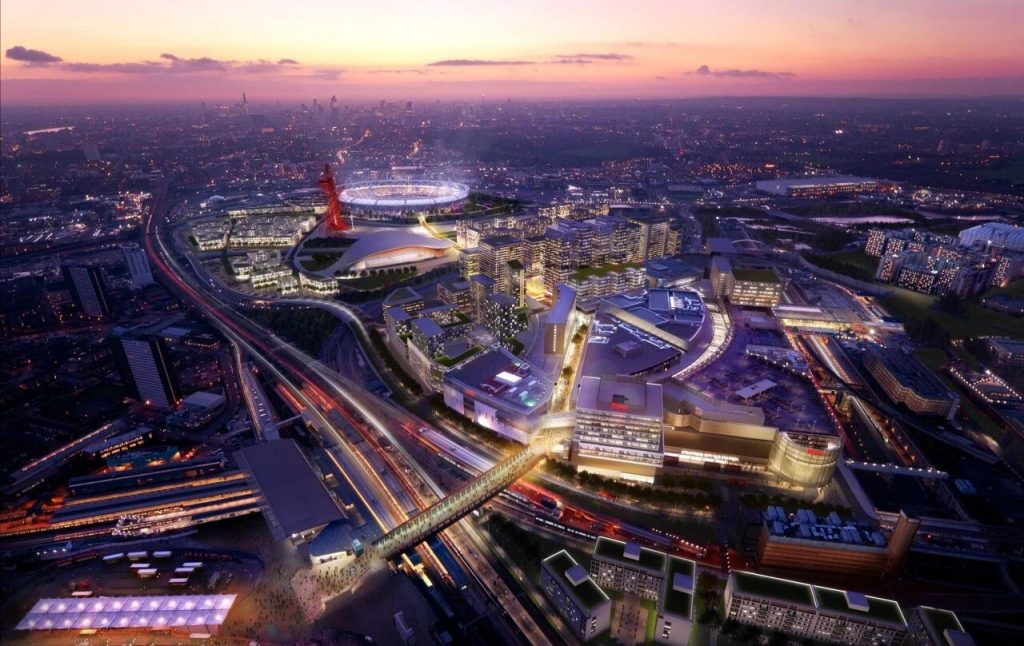
Through pedestrian pathway design, event-linked activities, and themed consumption scenarios, originally “event-based traffic” is transformed into “continuous foot traffic.” On game days, foot traffic increases by over 50%, and per-customer spending exceeds 20%—a tangible result of spatial organization and behavioral guidance.Three Paths to Building High-Level Resource-Based Commerce.Deeply leverage urban resources to create an ecological symbiosis.The “resources” of urban public-domain commerce include not only natural or cultural heritage but also time, memory, and social behavior patterns within urban operations. Activating these resources is not mere renovation—it is reinterpretation. Developers are responsible for allowing a space’s past, present, and future to coexist within a single framework. Outstanding projects often find breakthroughs within valuable “implicit resources.” Battersea Power Station in London exemplifies this approach. It is not a simple redevelopment but transforms industrial heritage into an urban cultural narrative. The original boiler house becomes luxury retail, the turbine hall houses Apple’s headquarters, and the chimney integrates an observation elevator—history is spatially preserved, creating a unique cultural memory site.
This classic model of urban reproduction revitalizes culture through space and commercial value through cultural regeneration.Create “unique resources” to build sustainable attractiveness.When urban resources are limited, resource re-creation becomes another path. Through content innovation and spatial curation, commercial entities can generate their own resources. Examples include:Themed IP zones: Nintendo theme areas, LV immersive environments, Sphere giant emotional IPs, creating new resources through emotional symbolism.Innovative spatial experiences: pocket parks, wedding showrooms, curated exhibition spaces, transforming commerce into “urban life theaters.”Public art and large-scale installations: Using visual impact to create urban symbols, amplifying social sharing and viral effects.Those who can create memorable spaces will capture urban attention. Commercial geography is no longer the absolute advantage; “content geography” defines future competitive spatial dimensions. Even low-cost designs often function as urban resource redistribution tools, making commerce a generator of urban memory.Operate with a “culture–emotion–community” ecosystem to maintain continuous traffic.The ultimate goal of commerce is not merely transactions—it is to rebuild urban relational connections.
Within a triad of culture, emotion, and community, the focus of operation shifts from acquiring new customers to retaining them. Public-domain commerce builds a “people–space–culture” loop through cultural identity, community participation, and emotional value.Successful examples like Shanghai’s Shangseng XinSuo, Taipei’s Eslite Life, and London’s Liberty thrive on humanistic resonance, allowing consumers to find reflections of identity: relaxation, poetry, healing, social interaction, and creativity. RET’s collaboration on Hangzhou Yuniaojie further amplifies this recognition into a city-level community, fostering ongoing cultural activities and social networks.Urban sociologist Ray Oldenburg criticized malls as “pseudo-public spaces” in The Third Place—seemingly open, yet fundamentally consumption-centered. The rise of urban public-domain commerce responds to this critique. It restores the public function of commerce, allowing people to regain participation, belonging, and spiritual connection beyond mere consumption.Urban public-domain commerce becomes a higher-level competitor not because of scale, but because it represents a new direction in urban evolution—commerce as a means, the city as the purpose. For developers, this is not merely a commercial strategy but a reflection and return to spatial ethics. It urges us to reconsider: How can commercial spaces truly integrate into the urban ecosystem? How can they interact organically with citizens’ daily behaviors, emotional needs, and social relationships? Only through this perspective can commerce transform from a container for consumption into a generator of urban life.