TaoTian Fought Three ‘Tough Battles,’ Giving Us a Clear Picture of the Future of Major Consumer Platforms
The popularity of Tmall’s Double 11 this year exceeded expectations. On October 15, 2025, the pre-sale of Tmall’s Double 11 opened, with 35 brands exceeding one billion yuan in sales in the first hour, and 1,802 brands doubling their sales compared to last year’s same period. The number of brands surpassing one billion yuan, the number of brands doubling their sales, and the active user count all exceeded last year’s numbers during the same period. Taking the apparel industry—known for having a higher return rate—as an example, data from Jiuqian’s backend platform shows that in the first phase of Double 11, Tmall’s apparel accounted for 57.5% of the total transaction volume, ranking first across all platforms. According to an analysis report from Analysys, Tmall’s apparel not only holds over 50% of the transaction share but also leads the industry with a growth rate of 15.8%, showcasing its home-court advantage.Against the backdrop of industry-wide growth pressures, these results are not only impressive but also signify a strategic leap by Tmall in its approach and timing. As early as 20 years ago, Chris Anderson pointed out in his book “The Long Tail” that “new distribution economies make us focus on the countless niche demands in the long tail, which, when aggregated, can form a new market as large as the mainstream market.”
In the face of increasingly fragmented, rational, and unplanned online consumption, we can see that Taobao initiated three “battles” in one year, ultimately aggregating long-tail demands and leveraging AI technology to drive growth.How Does Tmall Aggregate Demand?At the Tmall Double 11 launch event this year, the promotion was given three “firsts”: the first time it operated under the “Big Consumer Platform” strategy, the first time Taobao Flash Sale fully participated, and the first time AI capabilities were deeply implemented. Behind each “first” are countless self-challenges and iterations. The first battle for Tmall was a “battle with itself.” The core of this battle was to restructure operational efficiency and supply-demand quality on the original e-commerce battlefield.This year’s 618 shopping festival served as a training ground, where Tmall first introduced the metric of “GMV excluding refunds,” aiming to eliminate inflated orders at the source by guiding merchants to focus on real transactions, thereby driving improvements in supply quality and fulfillment capabilities. The results showed a 10% growth in GMV excluding refunds, enabling the platform to expand revenue while improving operational efficiency and laying the foundation for Double 11.On the product front, Tmall continued its “official discounts” mechanism, offering simple and direct discounts to enhance price perception and avoid complex promotions that could interfere with user decision-making.
According to Tmall President Liu Bo (Jialuo), the user rights channel was expanded, and the “AI Smart Discount Engine” achieved a 15% increase in conversion rates, ensuring that discounts were accurately delivered to high-intention users.User and Merchant Strategy.On the user side, 88VIP members not only contribute transactions but also provide high-quality and stable consumption feedback, acting as a key anchor for driving the “supply-side upgrade.” The platform helps high-quality demand find more matching options and helps brands build long-term value. On the merchant side, Tmall focused on expanding the boundaries and flexibility of supply. For quality new brands at different stages, Tmall provides layered support paths. For example, for mid-range merchants with potential, the “Thousand Stars Plan” offers assistance in site expansion, community operation, efficiency improvements, and event upgrades, enabling merchants to achieve scale leaps and long-term growth on Tmall. For new brands at stages 1-10, the “Treasure New Brand” program provides comprehensive support with incentives for new user acquisition, product co-creation, celebrity marketing, and more.The Second Battle: The Big Consumer WarTmall has not stopped optimizing its traditional e-commerce battlefield; it proactively launched the second battle—the Big Consumer War.
This year, Taobao Flash Sale participated as a “main player” in Double 11 for the first time, integrating previously dispersed local services such as takeout, supermarkets, and department stores into a unified platform, thus restructuring the “nearby + high-frequency + unplanned” instant consumption sector. According to data, by the eve of Double 11, Taobao Flash Sale had connected 37,000 brands and 400,000 stores, with orders growing exponentially, and its supply extended from standardized products to real-time needs, filling a gap in high-frequency scenarios that traditional e-commerce lacked.The Third Battle: The Future of AI-Powered Supply and Demand Matching.The third battle, however, is aimed at the future: How can AI tools improve the precision and efficiency of supply and demand matching? In traditional e-commerce platforms, mismatches between supply and demand often occur. On one hand, users struggle to express their needs accurately, leading to discrepancies in search and recommendations due to complex semantics. On the other hand, product information quality is uneven, which prevents high-quality offerings from being effectively identified and distributed.With the systematic application of AI capabilities, Tmall is trying to solve these issues and enhance supply-demand matching precision and efficiency. The platform introduced large-model capabilities in search and recommendation systems, which have been a focus of continuous iteration over the past year.
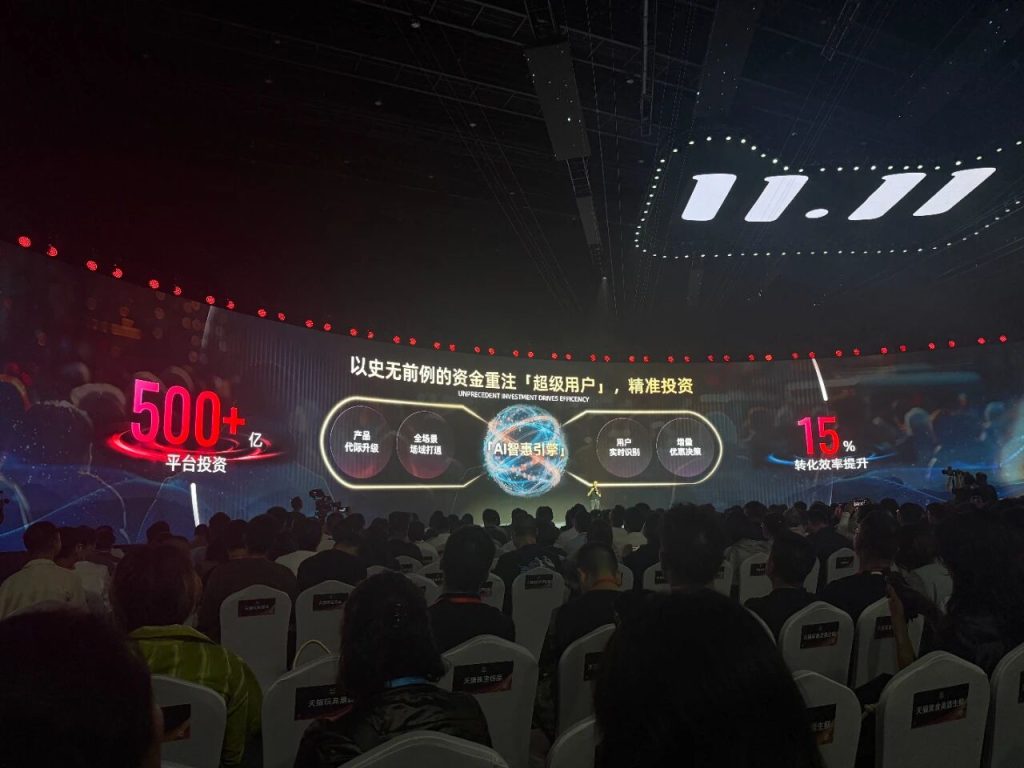
Generative AI has been fully integrated into search, recommendation, advertising, and other major traffic channels, enabling the system to understand complex natural language. According to a report from Alibaba’s China E-commerce Group, during the Double 11 launch, A/B testing and random experiments showed that search relevance improved by over 20%, and click-through rates for recommendation streams rose by about 10%, primarily due to enhanced system understanding of user demands.To support these algorithmic improvements, the platform has also undergone foundational changes in product understanding. Using a database of over 2 billion products, Taobao has built a structured product knowledge graph, using generative AI to complete, unify, and refine product details, solving issues such as missing fields, redundant descriptions, and unclear elements. This not only improves product matching in search and recommendation but also lays the groundwork for AI-guided shopping and automatic Q&A features.AI Tools for Merchants and Users.On the merchant side, Tmall has been promoting AI tools to assist in daily operations, such as image generation, customer service responses, smart pricing, and data analysis. Official data shows that AI image tools generate over 200 million product images and marketing materials per month, significantly reducing design costs, while AI customer service saves about 20 million yuan in operational costs daily, mainly through improved response efficiency and labor substitution.
These tools are particularly beneficial for small and medium-sized merchants in the cold-start and refined operations stages, helping reduce trial and error costs and improve supply quality.On the user side, Taobao is also innovating with AI-based features such as “AI Shopping List” and “AI Shopping Guide.” These tools aim to shorten the link between demand recognition and product presentation, helping users make more informed decisions with assistance from conversational AI. For instance, the AI shopping list automatically generates cross-category product combinations based on user intentions, while the AI shopping guide helps users clarify needs and adapt to more precise category searches.The Future of E-Commerce: A Smarter Big Consumer Platform.We are witnessing the e-commerce industry move into its next phase: transitioning from a “search-click-transaction” linear model to an intelligent operating system that understands demand, organizes supply, and ensures fulfillment. This transformation centers around replacing the traditional linear chain with a more complex, multidimensional system that integrates seamlessly with users’ daily lives. Users will only need to express vague issues such as “the living room is too messy,” “I keep forgetting my umbrella,” or “the kitchen counter is too dirty,” and the platform will identify their intent, understand their preferences, complete the context, and then present a set of products that best solve their problems from millions of offerings.
Tmall is building a new platform centered on consumption, with AI as its brain and local life as its nerve system. The first step is to make AI truly the operating system of e-commerce. From search algorithms to recommendation logic, product tagging to user profiling, the platform is training itself to “understand demand rather than respond to keywords.” The second step is to break through long-term value in structured user groups. With a user base of over a billion, the platform has enough data for merchants to build sustainable growth models. The third step is to turn the product pool into a supply engine and the offline network into a fulfillment system. Behind Taobao Flash Sale lies the platform’s ability to instantly organize local demand: brand stores, convenience stores, and community warehouses are incorporated into the scheduling system, enabling minute-level delivery.Ultimately, these efforts aggregate fragmented, unplanned, and non-standard consumer intentions into a recognizable, predictable, and fulfillable commercial network. Through its deep understanding of everyday life, Tmall is transforming tiny daily problems into concrete business opportunities. In the past, e-commerce’s core abilities were “traffic distribution” and “product matching.” Now, platforms capable of penetrating daily life, understanding users, and activating supply are the protagonists of the next era.