Strategic Transformation: How Department Stores Are Experiencing a ‘Second Spring’
In Recent Years, Department Stores Have Faced a Wave of Closures.In recent years, the department store industry has witnessed a profound wave of closures. In the first half of 2025, numerous department stores—including Parkson, Dashang Mcare, Galeries Lafayette, Tianhong Shopping Mall, and Hongchang Department Store—shut their doors, with some having operated for decades.In March, Changsha Apollo Commercial Plaza announced a closure for renovation and upgrade. By the end of the month, Galeries Lafayette’s Southwest flagship store closed just a year and a half after opening. Huizhou Junshang Department Store, Lanzhou New World Department Store, and Beijing Fuxingmen Parkson also joined the list of closures.This series of shutdowns clearly signals that traditional department stores are facing unprecedented survival challenges.Analyses of the closures point to aging business formats, outdated facilities, and declining competitiveness as unavoidable issues for these “legacy” department stores. Under the pressure of emerging commercial formats, e-commerce platforms, and diversified retail models, traditional department stores have gradually lost market share and consumer favor.However, closures are not the end—they are the starting point for industry self-reinvention.
A group of forward-thinking department stores is exploring the path from traditional “retail” to modern “lifestyle destinations” through precise positioning, spatial restructuring, format innovation, and cultural empowerment.Spatial and Experiential Transformation.Traditional department stores often struggle with space issues: chaotic circulation, cramped layouts, and monotonous experiences. These have become major bottlenecks restricting growth. During transformations, space and experiential redesign have become the primary breakthrough point.Zhenjiang Yabaiban’s renovation exemplifies unique spatial thinking. Unlike other struggling department stores, Yabaiban launched a two-year “adjustment plan” at the peak of profitability, leveraging incremental adjustments to upgrade the store into a shopping center format.To address core pain points—tight layouts and narrow corridors—Yabaiban redesigned nearly 25,000 square meters of space, accounting for half of the entire retail area. The original circular flow was replaced with a linear flow, enhancing transparency and openness. By reducing the size of first- and second-floor island counters and removing some, they widened narrow corridors and expanded the central atrium, leaving ample space for brand adjustments and multi-use areas.
For ambiance, Yabaiban cleverly incorporated local cultural elements, such as installing art pieces reflecting Zhenjiang’s “mountains in water, water in mountains” philosophy near escalators and creating green rest areas with beach-style seating on Level 5, offering a regionalized leisure experience.This spatial renovation not only enhanced physical comfort but redefined the function of department store space—shifting from mere product display to a comprehensive experiential environment.Beijing Friendship Store explored another path of spatial renewal. The management team adopted a core principle of “light intervention, strong character, sustainability”, abandoning large-scale demolition and reconstruction in favor of a precise, acupuncture-like approach.The nearly 10,000-square-meter closed rear courtyard was transformed into an open Friendship Garden, with lawns, plants, and miniature landscapes creating a 3D green urban space for all-day use. Idle buildings were repurposed for tenants while preserving historical character, and the main building’s 1972 façade is planned for restoration, combined with artistic night lighting to revive the classic architecture.This “light renovation” approach preserves historical memory while reshaping space functionality and adding value. The store also targets the “new youth” market, integrating lifestyle consumption and a “daytime café, nighttime bar” social atmosphere, introducing cafes, bars, Western cuisine, desserts, light meals, and tea houses.
Since its soft opening in May 2025, sales soared to 167 million yuan from January to September, up 669.12% year-on-year; daily weekday traffic averages 5,000, with weekends and holidays exceeding 10,000—tens of times higher than pre-renovation levels.Shuang’an Mall’s spatial renovation is equally noteworthy. Its façade uses glass and ceramic panels to enhance transparency and depth; interior colors are unified and highlighted, while greenery adds vitality. Floor signage and restroom design respond precisely to user needs, creating a complete experiential loop—from visual attraction to emotional resonance to convenient use. These details reflect the human-centric shift in modern department store design.Brand and Format Innovation.Aging business formats are key to the decline of traditional department stores. Renovations now focus on breaking floor monotony, introducing first-store economy, and strengthening non-retail formats.Observations show that more shopping centers are conducting thematic transformations to cater to different audiences. Zhenjiang Yabaiban, for example, positioned scarce mid-to-high-end brands to create a high-end consumption destination. Transitioning from “broad and general” to “refined and specialized,” it consolidates its image through high-end leadership + full customer coverage. First-store introductions and trendy young brands expand its customer base, while adding F&B, entertainment, and lifestyle offerings to create an integrated “lifestyle destination”.
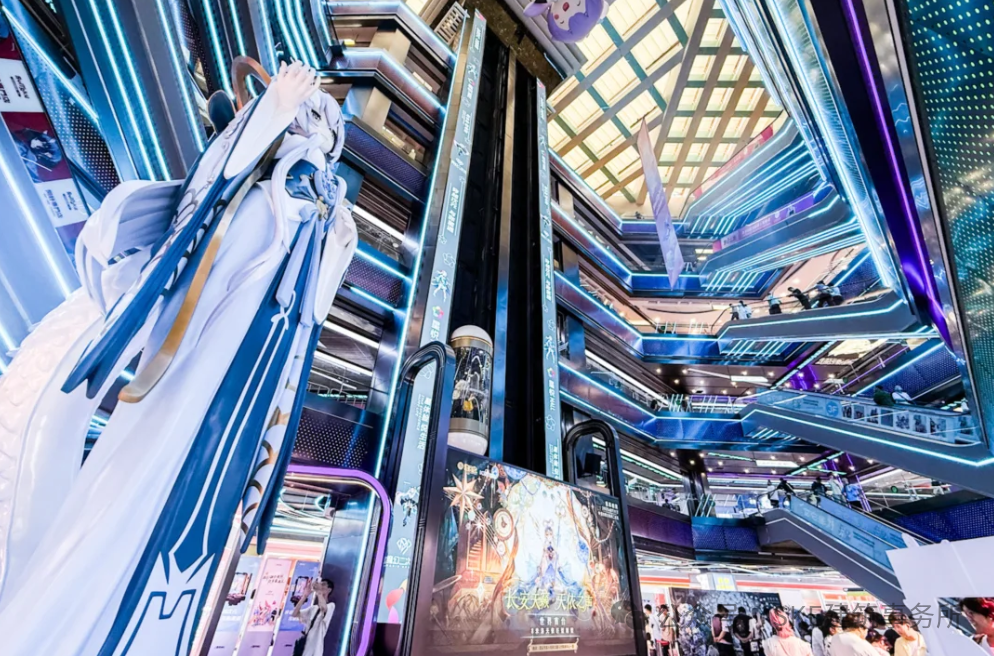
A clear floor-differentiated brand matrix enhances uniqueness perception and overall competitiveness.For niche markets, several department stores target specific demographics. Chengdu Qun Guang Plaza, Xi’an Xingyue Mall, Chengdu Tianfu Red, and Shanghai Paris Spring·Yuehui Tianshan have successfully transformed into anime-themed malls. Qun Guang Plaza collaborated with “Magical Second Dimension” IPs across floors L1, L2, and B1 (~9,000 sqm), featuring 14 brands including four China-first stores. Popular IPs like One Piece, Conan, Hatsune Miku, Pokémon, and Chibi Maruko-chan offer full-scene merchandise—from limited figures to customized cakes. Optimized flow, community engagement, and scene linkage allow anime fans and existing customers to complement each other, creating synergy between high-end beauty brands upstairs and anime space below.Xi’an Xingyue Mall introduced 40+ anime brands, an XR cinema, and themed dining, converting commercial space into a cultural consumption hub. An 8-meter Luotianyi statue in the atrium creates a strong photo-op landmark, while each floor hosts immersive zones for anime, lifestyle, and entertainment.Yuxiang Shiguangli (former Chongqing Jiulong Department Store) targets the silver economy, creating a “one-stop ageless living circle.” Its design is a textbook example of “lifestyle aesthetics”: B1 hosts local Chongqing cuisine; L1-L5 offer comprehensive retail; immersive rest areas on L2-L5 evoke multi-generational memories; L6 focuses on spiritual consumption, with music, dance, photography courses, wellness talks, and elder-friendly exhibits.
Yuxiang Shiguangli (former Chongqing Jiulong Department Store) targets the silver economy, creating a “one-stop ageless living circle.” Its design is a textbook example of “lifestyle aesthetics”: B1 hosts local Chongqing cuisine; L1-L5 offer comprehensive retail; immersive rest areas on L2-L5 evoke multi-generational memories; L6 focuses on spiritual consumption, with music, dance, photography courses, wellness talks, and elder-friendly exhibits.Refined Operations as Core Competitiveness.In the wave of department store transformations, refined operations have become a core competitive advantage. More stores are shifting focus from managing “products” to managing “people.”Shuang’an Mall provides personalized service to over 2,000 VIPs through “U-Yuetang,” a multifunctional space including a member reception center, VIP rooms, event halls, nursing rooms, and 24/7 hotlines—demonstrating deep service-oriented practice.Chengdu Tianfu Red updates sets weekly, hosts regular anime exhibitions, and creates social spaces with cosplay dressing rooms, dance areas, themed music, and flea markets for secondary merchandise. These initiatives strengthen shopping experience, social interaction, and customer loyalty. Sales for the first five months of 2025 rose 150%, attracting ~70 niche brands, with anime-related offerings accounting for over 70%—making it one of the leading anime-focused malls in Southwest China.
At its core, refined operation is a strategic revolution from managing “space” to managing “people,” transforming cold transactional environments into emotional communities with stories, belonging, and consumer value.Conclusion: Reconstructing Value and Retail Models.Department store transformation is not a wholesale denial of the past. By leveraging spatial redesign, format innovation, cultural empowerment, and refined operations, traditional department stores reconnect with modern consumers—a profound value reconstruction and business model revolution.As Director Guo Zengli of China Shopping Center Development Association notes, the industry faces a critical point of “cyclical challenges and iterative creation.” Only through ecosystem values and sustainable development can department stores achieve new-quality commercial growth.From Zhenjiang Yabaiban’s spatial revolution, Beijing Friendship Store’s light renovation, Tianfu Red’s niche engagement, to Zhongbai Building’s cultural curation, these examples confirm that commercial real estate is moving from scale replication in a growth era to refined creation in a stock era.Through five key paths—spatial scenarization, format diversification, customer segmentation, local cultural integration, and community-driven operations—department stores have upgraded from “commercial facilities” to urban infrastructure, completing a transformation from transaction space → lifestyle space → value space and charting a distinct path for China’s retail development.