Southern Vegetables, Northern Transport’: How Elephant Supermarket Keeps Freshness Across Thousands of Miles?
Food is the Foundation of Life.Competition in the fresh food sector is becoming increasingly fierce, and ensuring a high-quality supply is the core focus. China’s vast land and rich resources create significant differences in fresh vegetable consumption between the north and south. In the southern regions, residents can enjoy fresh leafy greens every day, but due to seasonal changes and supply chain limitations, these vegetables are often hard to reach in the colder northern regions during autumn and winter.To address the demand for fresh vegetables in the north, Elephant Supermarket has leveraged real-time retail supply chain optimization. By introducing a “reverse supply, quality control first” model, they have pioneered the use of internationally leading temperature-controlled freshness-locking technology throughout the entire production and sales process. This has created a new “Southern Vegetables, Northern Transport” channel, helping local agriculture thrive and boosting farmers’ incomes, while delivering “highland vegetables” from Yunnan to northern residents’ tables in as little as 48 hours.This temperature-controlled freshness-locking journey begins at 3 AM, after heavy rain, as harvesters in Yunnan’s greenhouses skillfully pick rows of lettuce, storing them in the dark before sunrise.
Meanwhile, quality control staff check each batch of vegetables, uploading temperature and other data in real-time to the system. In 48 hours, the fresh vegetables travel nearly 3,000 kilometers, maintaining a consistent 4°C temperature, and arrive directly on dining tables in Beijing.A Fresh Supply Chain Solution.Building this reverse supply chain, Elephant Supermarket has spent three years testing and refining it, creating a “fresh vegetable landmark matrix” across multiple production areas in Yunnan, Xinjiang, Hubei, Guangdong, and more. Finding stable quality control for fresh, tender leafy greens is no easy task. Historically, China has seen a “Northern Vegetables, Southern Transport” market pattern, but in recent years, weather events like heavy rains have caused mismatches between supply and demand, especially in the autumn and winter months.Vegetables that seem ordinary can have significant seasonal quality differences between the north and south. In the southern regions, where the climate is milder—take Yunnan, for example—the average altitude is about 2,000 meters, offering “natural air-conditioning” conditions. Winters are not harsh, summers are not extreme, and the temperature difference between day and night can exceed 10°C.
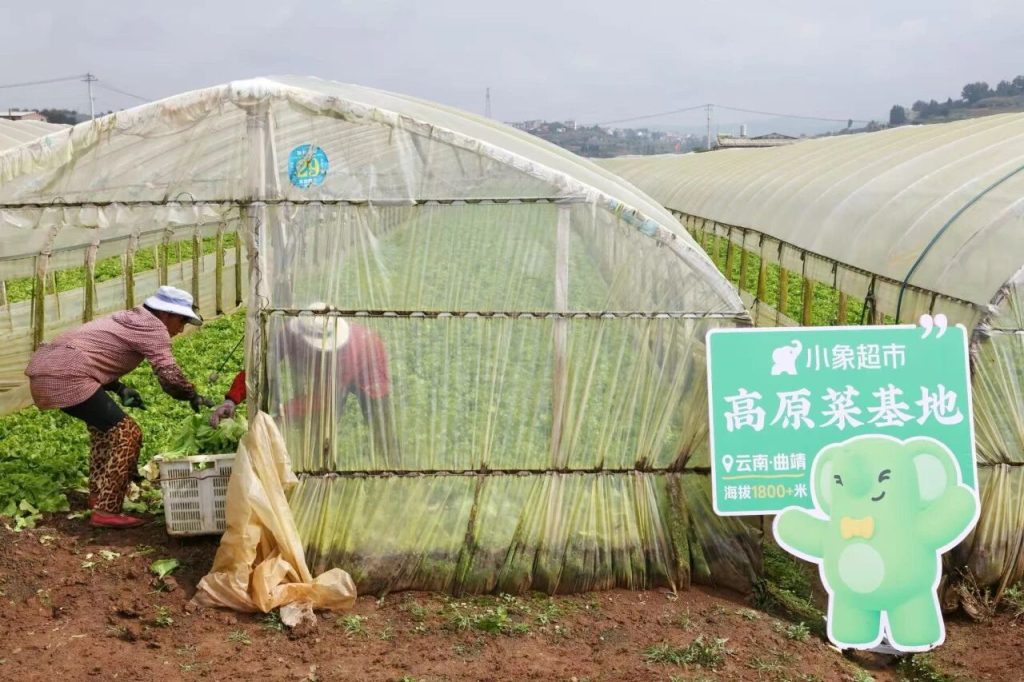
This unique environment effectively reduces pest and disease occurrences, extends the vegetable growth cycle, and greatly enhances the nutritional value and flavor of the vegetables.So, how can people in the north enjoy fresh, high-quality vegetables during the cold winter months? Elephant Supermarket’s solution is the “Southern Vegetables, Northern Transport” model—creating a reverse supply channel that ensures high-quality vegetables travel efficiently.Exploring a New Supply Model.Elephant Supermarket’s innovative supply model, which focuses on “direct sourcing, order-based planting, and preemptive quality control,” has been integrated across the entire production and sales process. The company has pioneered the use of leading-edge “temperature-controlled freshness-locking” technology in the domestic fresh retail sector. This journey has taken them three years to perfect, resulting in the creation of the “48-Hour Low-Temperature Journey” from Yunnan’s greenhouses to Beijing’s dining tables.To ensure the highest quality, Elephant Supermarket has mastered several key techniques in the storage and transportation phases. For example, the company uses vacuum pre-cooling technology, which lowers the boiling point of water by reducing atmospheric pressure.
This allows the water to evaporate quickly, drawing heat away from the vegetables and rapidly cooling them in less than 30 minutes. As a result, the vegetables are kept fresh and their spoilage rate slowed.Furthermore, Elephant Supermarket is the first platform in the industry to apply temperature-controlled freshness-locking technology on a large scale, unlike the traditional water-immersion preservation techniques used by others. After implementing this technology, customer complaints about leafy vegetables decreased significantly. Industry experts predict that vacuum pre-cooling and other temperature-control techniques will become the standard for fresh food retail platforms nationwide within the next 1-2 years.Direct Sourcing and Standardization.To ensure fresh vegetables from the source, Elephant Supermarket has partnered with local producers to establish direct sourcing bases, using an order-based agriculture model. Orders are placed 2-3 weeks in advance, specifying the variety, size, quality standards, and harvesting times. More importantly, quality control staff are stationed at these production sites to monitor the entire process, ensuring a fully integrated quality system.
This proactive approach enables Elephant Supermarket to maintain higher quality standards than industry averages.Evolving the Fresh Food Sector.China’s fresh food retail market has entered a new stage of deep competition and platform differentiation. Competition is no longer about being “faster” or focusing on price wars with subsidies, but rather a competition of “capabilities” centered on supply chain efficiency, user experience, and profitability. The development of the “Southern Vegetables, Northern Transport” supply chain is a transformative shift, not just about increasing SKUs, but about creating deep changes across the supply chain and consumer end.Highland vegetables, with their unique regional flavor and higher quality, have become signature products for platforms, helping them stand out from the “cookie-cutter” competition. This also helps platforms build a more trustworthy brand image, free from the low-level competition focused solely on price. The ability to control the supply chain, ensure consistent quality, and provide excellent user experiences will become the key to success for platforms in the next phase of competition.Elephant Supermarket’s increasingly advanced supply chain capabilities have become a core competitive advantage, allowing them to break free from low-level price wars and establish a new growth model for fresh food retail platforms.