Shopping Malls Are Evolving: It’s Not About Size, It’s About ‘Understanding Me
Once upon a time, a 100,000-square-meter shopping mall was the benchmark for commercial success. Today, however, a 7,000-square-meter silver-haired-themed space can generate even greater value. The once-proud “all-demographic” positioning is now being replaced by precise “niche community operations.” This is not a regression in business—it’s a new direction in commercial real estate evolution.Currently, China’s commercial real estate market has fully entered a stock era. In this phase, the industry focus inevitably shifts from quantity to quality, with precision in services and localization of scenarios becoming key competencies for shopping centers. Consumer data in 2024 further underscores the urgency of this transformation: nationwide retail sales of consumer goods rose by 3.5%, lagging behind GDP growth of 5%, and consumption contributed 44.5% to economic growth. Meanwhile, retail services grew by 6.2% year-on-year, far exceeding overall retail growth, indicating that the market is transitioning from goods consumption to service consumption, and from mass consumption to niche, community-oriented consumption.Against this backdrop, commercial projects that proactively lower barriers and deeply cultivate specific fields—such as silver economy, niche community operations, community empowerment, sports ecosystems, and women-friendly concepts—are not only gaining market recognition but also redefining the value boundaries of commercial real estate.
Innovation in the Silver Economy.Leveraging deep insights into consumption trends, Bailian Flourishing Square officially opened on October 28, 2025, at Shanghai No.1 Department Store, spanning floors 7–8 of Buildings A and B, creating a 7,000-square-meter cross-floor commercial space. As Shanghai’s first silver economy lifestyle brand developed by a commercial enterprise, the project embraces the concept of “Boundless Blossoms, Infinite Living,” precisely targeting the “6275” new silver generation (active seniors aged 60–75), completely shattering traditional stereotypes of senior-oriented retail. This demonstrates the project’s ability to generate new demand from the supply side.Bailian Flourishing Square centers its design on “scenario solutions,” integrating six lifestyle scenarios—social networking, independent living, health management, hobbies, financial planning, and intergenerational family life. The seventh floor emphasizes “Ageless Self,” focusing on social engagement and interest-based classes, while the eighth floor highlights “Smart Enjoyment,” merging health, digital intelligence, and family scenarios to create a “large yet engaging” browsing experience.Moving forward, the brand will continue elderly-friendly renovations and develop Touch-Care corners, optimizing signage, adding resting areas, and upgrading accessibility to create a warm and convenient “ageless” environment.
In terms of commercial offerings, the project features “Flourishing Square Select,” covering apparel, beauty, food, and health products, along with cross-border and AI smart zones, introducing international senior-friendly products and tech services such as health monitoring and intelligent companionship. In this way, Bailian Flourishing Square upgrades traditional retail into a comprehensive lifestyle solution, offering a path for generating new consumption through innovative supply.Deep Niche Community Operations.As consumer markets become increasingly segmented, niche social demands are growing, fundamentally changing how shopping centers define their audiences. Traditional demographic profiles were broad and generic—middle-class white-collar workers, fashion enthusiasts, or sophisticated moms. Today, profiles resemble cultural community tags—pet owners, anime fans, actuarial experts, adventure seekers.Leading this trend, on October 1, 2025, Weibo IN Cross-Dimensional Gravity Field opened on the east side of Chaoyang Park, Beijing. Renovated from the 2008 Olympic beach volleyball stadium, the project spans approximately 42,000 square meters and exemplifies the fusion of urban renewal and content innovation. Weibo IN pioneered an “e-sports + anime” themed commercial model, accurately capturing young consumers’ interests. The project hosts international toy brands such as TAMASHII NATIONS, Megahouse, and Hasbro Transformers, alongside top anime culture brands like Animate Cafe and bilibiliGoods. Flagship stores account for over 30% of tenants and 50% of the area, including North China’s first Animate Cafe and nationwide first stores like Three-Body 4D Space.
At the heart of Weibo IN is its Diamond Center, the largest professional e-sports arena in North China, seating 1,500 and equipped to host international competitions, performances, conferences, and large-scale events. Future plans include introducing high-profile IPs, top-tier international competitions, and diverse cultural activities, continuously enriching urban cultural consumption scenarios. This deep niche community operation exemplifies the shift from broad audience targeting to precise community engagement.Cultural Empowerment of Community Commerce.Community commerce is evolving from traditional convenience services to cultural experiences, integrating commercial and social functions. D15 Lifestyle Aesthetics Hall, located in the core area of Wenquan Town, Haidian District, Beijing, covers 17,000 square meters and is part of the town’s independent brand “Xingquan Hui.”Built on the “Six Courtyards in One” concept, D15 integrates shared innovation, refined living, family time, and neighborhood gatherings. Its design engages all six senses—sight, sound, smell, taste, touch, and mind—offering experiences through music, chess, calligraphy, and painting. Housing over 40 quality brands, with more than 60% debuting locally, the hall features dining, retail, bookstores, education, fitness, beauty, and izakaya. The in-house cultural brand, Gulen Bookhouse, combines a bookstore, shared reading, children’s activity space, café, cultural salon, and study areas, centered on Wenquan Town’s local IP “Gulen,” creating a rich literary atmosphere.
Here, residents can enjoy coffee while immersing themselves in a peaceful reading environment.Building Sports and Lifestyle Ecosystems.As commercial entities are expected to establish recognizable symbols and IPs, themed commercial centers naturally emerge. For example, in the era of experiential economy, sports-themed complexes tap into consumer demand for activity. On May 17, Nanjing’s first cycling-themed non-standard commercial street, Zijin·Zhong’ai, opened near the East Entrance of Zhongshan Scenic Area, integrating sports, culture, and leisure. Anchored by “Cycling+,” it introduced seven first-store brands in Jiangsu and Nanjing, covering mountain bikes, road bikes, e-bikes, and motorbike clubs, alongside fitness, bookshops, tennis, outdoor sports, archery, and other lifestyle amenities, forming a cycling-centric ecosystem. The street’s “non-standard” design emphasizes low-carbon mobility and green landscapes, with 5.8-meter elevation differences and smooth, step-free routes.Similarly, Shenyang’s first sports-themed commercial complex, Global Harbor Motion City, opened May 1, 2025, with over 100,000 square meters and the country’s first “Sports+” ecosystem cluster. Featuring a 266-meter sky-high light track, Northeast China’s first commercial skatepark, the province’s tallest indoor climbing hall, and an RMCC-approved go-kart track, the complex merges professional sports facilities with commercial space, creating new consumption scenarios.
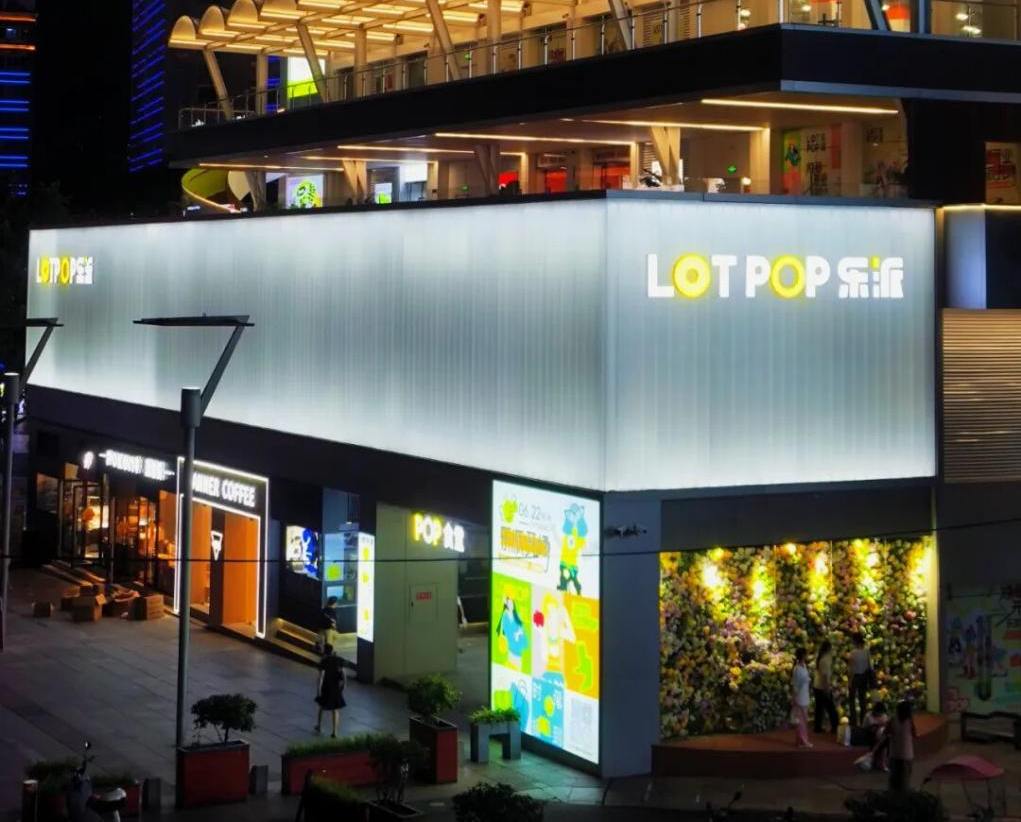
Signature competitions like skateboarding, fencing, urban climbing, and martial arts leagues draw consistent traffic, exemplifying event-driven commercial operations.Women-Friendly Commercial Innovation.With increasingly personalized consumption trends, gender-specific innovation responds to women’s unique needs. On June 22, LOT POP opened in Chongqing Yangjiaping, retaining the original women-oriented theme while introducing trend-forward and quality-focused concepts. Designed from a “female perspective,” it offers layered, immersive experiences: B1 POP Dining Hall hosts diverse cuisine; L1 LOT SHINY covers all female consumer categories; L2 LOT CHIC and L3 LOT GRACEFUL focus on designer apparel and lifestyle; L4 LOT COZY provides wellness and light social spaces; L5 LOT HAVEN is a designer hotel offering tranquil lodging. Additional amenities include themed makeup rooms, nursing rooms, selfie areas, complimentary essentials, and rooftop social spaces. This approach illustrates how deep audience insights enable shopping centers to evolve from consumer management to community management.The New Logic of Commercial Real Estate.Collectively, these innovative practices reflect profound changes in commercial real estate’s foundational logic.The industry is transitioning from “commission-based unified management and scattered operations” to “eco-collaborative operations and scenario co-creation,” and from “leading experiential consumption space supply” to “responsive, segmented scenario innovation.”
Specifically, this shift occurs on three levels:From economies of scale to economies of scope: traditional malls rely on large traffic and diverse brands, while vertical commerce fulfills diversified needs of targeted communities.From space rental to scenario co-creation: the relationship between operators and tenants evolves to a new stage of operational empowerment and collaboration.From commercial facilities to urban infrastructure: advanced vertical commerce transforms from mere retail to essential city infrastructure.As markets further segment and competition intensifies, vertical commerce will explore diverse development paths. AI, big data, and other technologies enable deep personalization, while cross-industry integration creates new value. Successful vertical commerce also blends multiple social functions, forming complex, multifunctional ecosystems.According to the China Chain Store & Franchise Association, the unchanging law of commerce is to evolve alongside society and consumer behavior. By offering tailored consumption, service, lifestyle, social, and community scenarios, commercial complexes can transition from mere retail facilities to essential urban infrastructure. In the era of vertical commerce, depth equals height, and focus equals breadth. This strategic shift from scale competition to depth competition is both an adaptation to market dynamics and a return to the essence of commerce: deeply rooting in each niche to genuinely meet consumer needs and create lasting enterprise value.