Beijing’s Historic Landmark Gets a Bold Makeover, Striking a Chord with Young Consumers
Landmarks are almost a standard feature of every city. They often serve as the city’s first introduction to the world, as well as a spiritual reference point embedded in the collective memory of local residents. Landmarks come in many forms: sometimes they are ancient structures that have stood for centuries; sometimes they are high-tech skyscrapers; sometimes they are well-known corporate headquarters. These landmarks are not just geographic markers—they are tangible expressions of a city’s culture, history, and spirit.As time marches forward, some once-glorious landmarks gradually fade into obscurity, tucked away in corners of the city, suffering from aging facilities, functional disconnections, and declining vitality. They urgently require innovative revitalization to restore their life and relevance. At this moment, transforming old landmarks into destination-oriented commercial spaces has become a highly valuable innovation. This approach can activate idle assets, turning old landmarks from “symbols of urban memory” into “consumer traffic hubs,” eventually evolving them into new benchmarks for urban commercial upgrades.Following this thread, we analyze three types of typical projects in Beijing—industrial heritage transformations, historic cultural landmark renewals, and micro-renovations of old hutongs—to explore the “customer-attraction secrets” of turning old landmarks into destination-oriented commercial hubs.Industrial Heritage Transformed into “Micro-Vacation Destinations”.Unlike traditional regional commerce, the core of destination-oriented commercial spaces is to “create a reason for consumers to make a special trip.”
Old landmarks, with their innate historical uniqueness, serve as ideal carriers for destination-based commerce. However, successfully revitalizing old landmarks is no easy task. It requires solving two major challenges: “cultural disconnect” and “blind trend-following.” Simply displaying historical elements as ornaments is insufficient; there must be a consumer experience that allows for deep engagement. Likewise, blindly introducing trendy concepts that clash with the landmark’s character should be avoided.Shougang Park, which carries the memory of Beijing’s industrial era, offers a valuable reference. By preserving key structures like the No. 2 and No. 3 blast furnaces, the project emphasizes the inherent “industrial aesthetic” of the architecture, giving it a brand-new value proposition. Walking through the park, visitors encounter a collision of past and present: rusted steel components underfoot and contemporary art installations scattered across the grounds. The contrast of old and new is particularly vivid at the No. 3 blast furnace.Once a high-temperature iron furnace, the No. 3 blast furnace processed ore and flames day and night, with towering structures, interlacing pipes, and massive hot air furnaces—witnessing the industrious pace of industrial production. Today, it has been transformed into the park’s most distinctive exhibition center, pioneering the adaptation of large industrial buildings for civilian use.
Shougang’s Liugonghui project breaks traditional commercial boundaries, becoming a self-sufficient, irreplaceable destination commercial hub. According to Winshang data, 38.14% of visitors come from beyond a 10 km radius locally, ranking first among all customer segments; non-local visitors account for 9.68%. This demonstrates that Liugonghui attracts both dedicated local visitors and out-of-town tourists, positioning it as a “micro-vacation” destination blending industrial heritage with modern vitality.Liugong Park’s success has shattered the stereotype that industrial heritage transformations equal “low-end creative spaces.” It reconstructs the commercial value logic of industrial heritage, shifting consumer spending from merely purchasing goods to paying for rare industrial experiences and historical-cultural resonance. Multiple commercial formats benefit from this contextual advantage and command higher premiums.If Shougang’s Liugonghui serves as a “comprehensive urban living room” from industrial heritage, 798 Art District represents a distinct path of transforming industrial heritage into a “vertical art landmark.” Located at the former 718 Joint Factory of the Ministry of Electronics Industry, 798 Art District is an art hub developed from Bauhaus-style factory buildings. With 100,000 m² of commercial space and numerous industrial-style cafés and restaurants, it hosts 72 brands including Starbucks Reserve, Museum of Encounter, and UCCA Lab flagship stores.
The area is rich in cultural and artistic offerings, with over a dozen galleries, art centers, and creative studios, making it one of Beijing’s cultural landmarks.798 Art District frequently hosts exhibitions and creative markets, attracting young, art-loving consumers from afar. Winshang data shows that visitors from beyond 10 km account for 49.16%, with non-local visitors making up 14.37%. These figures confirm its role as a “cross-regional cultural tourism landmark.” For the general public, 798 is not only a daily gathering spot for Beijing’s art youth but also a must-visit destination for outsiders seeking Beijing’s creative cultural energy.Beijing has numerous industrial heritage sites successfully transformed into commercial destinations. Shougang Liugonghui and 798 Art District are benchmarks that seamlessly integrate historical industrial aesthetics with modern consumer spaces, serving as exemplars for urban renewal. These projects provide valuable reference models for the nationwide upgrade of 264 national industrial heritage sites, proving that industrial heritage can transcend limitations to become destination-oriented commercial hubs.From Cultural-Historical Landmarks to Cultural Trend Hubs.In destination-oriented commerce, strong cultural DNA, flagship stores, and unique experiential formats are key to attracting young consumers.
By creating iconic check-in scenes, projects enhance social media visibility, which often converts into real-world foot traffic—critical for breaking into wider commercial markets.Longfu Temple, a 600-year-old royal temple, sits within the “Forbidden City–Wangfujing–Longfu Temple” cultural triangle, carrying the commercial memory of old Beijing. With Ming and Qing architectural designs, Xuan-Nan cultural heritage, and synergies with the Forbidden City and Guozijian, the site inherently possesses the “cultural destination” gene. The Longfu Temple district blends temple layouts from the Ming and Qing eras, street-market atmospheres from the Republic era, and landmarks like Dongsi Market and Longfu Building. The redevelopment strategy emphasizes “preserving historical axes and continuing architectural memory,” maintaining architectural features from multiple eras.Phase I and II of Longfu Temple introduced high-experience formats including Longfu Performance New Space, Kaixin Mahua A99 Theater, All-space, Laipai Vinyl, Funfly Travel World, and 76 brand stores including four city-first brands such as Xiaoguo Factory and Outopia. Additionally, Red Star Fresh Milk Cake Shop and 7 Mesh Cycling Theme Store represent national firsts.A similar approach is seen in Qianmen Street–Beijing Fun, which follows the principle of “preserve historical axes, continue architectural memory.” Beijing Fun consists of eight standalone buildings around Quanye Field, forming a main street, three plazas, and multiple hutongs, with 146,000 m² of commercial space.
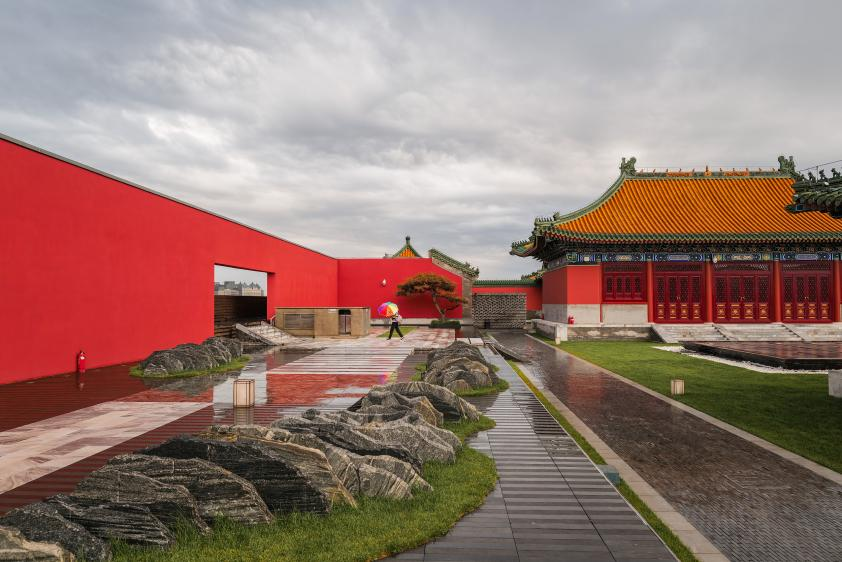
It features four commercial formats: themed dining, art and culture, experiential interaction, and premium lifestyle. 37 brands, including Manchester Dream Theater, VIVINEVO, and MIRAGE, opened flagship or first stores, attracting a high-intent consumer group aged 25–44 (53.58%). Winshang data shows 36.58% of visitors come from beyond 10 km, and 33.7% are non-local. Combined, cross-regional and out-of-town visitors exceed 70%, aligning with the destination-oriented commercial model of “breaking geographic boundaries to attract consumers.”A single old landmark may struggle to maintain sustained attraction. By linking nearby cultural and tourism resources to form a “destination cluster,” visitor traffic and spending can be amplified. Longfu Temple and Beijing Fun are vivid examples of this strategy. Longfu Temple leverages the cultural triangle to complement the Forbidden City and Wangfujing: the Forbidden City satisfies cultural heritage needs, Wangfujing fulfills traditional shopping demands, and Longfu Temple offers immersive cultural-trendy experiences, together creating a complete cultural-tourism-commercial loop. Beijing Fun, part of the Qianmen Dashilan commercial area, complements Qianmen Street and Dashilan with a tiered combination of traditional foundations, advanced experiences, and authentic local lifestyle, enhancing the commercial value along the city’s central axis.Hutong Courtyards as “High-End Cultural Destinations”.
At some point, Beijing hutongs became symbolic of Old Beijing’s cultural identity. Their historical textures, original living scenes, and intangible heritage elements are unique cultural assets and core potential for commercial upgrades. How to deeply explore hutong culture and transform old hutongs into destination-oriented commercial spaces combining cultural experience and consumer appeal has become a major topic in Beijing’s urban renewal and cultural commerce.Beijing’s core commercial areas are limited, and hutong commerce is smaller in scale, mostly advanced through “micro-renovations,” with high-end transformations being rare. Zhonghai Daji Alley, the birthplace of Xuan-Nan culture and surrounding heritage buildings such as Kang Youwei’s former residence, offers rare urban resources with its courtyard layouts and hutong scenery, filling a market gap for “high-end hutong commerce.”Focusing on a “courtyard commerce cluster,” Zhonghai Daji Alley spans 88,000 m² of commercial space, using a “hutong scenery + premium consumption” design. It introduces 128 brands, including six first stores, across retail, dining, cultural and entertainment, and lifestyle services, enabling consumers to dine and shop within courtyards for an immersive cultural and high-end social experience.Since opening, Zhonghai Daji Alley has attracted high-end business professionals and cultural enthusiasts, maintaining high-quality foot traffic. Data shows visitors from beyond 10 km account for 31.35%, and non-local visitors 11.45%, consistent with destination-oriented commercial principles of attracting cross-region consumption.
Zhonghai Daji Alley’s “precise audience targeting + scarce scene supply” demonstrates that not all projects require mass coverage. A smaller, high-end route with differentiated competition can achieve higher unit profitability. Winshang data confirms this, with retail average spending at 600–700 RMB per visit and lifestyle service spending at 200–300 RMB, significantly higher than comparable commercial areas, providing a new model for transforming old landmarks into destination-oriented commercial hubs.Beijing’s “hutong economy” and “check-in economy” are not isolated cases. Beyond Zhonghai Daji Alley, Yangmeizhu Slant Street, Xizongbu Hutong No.7, Xixinglong Street, and Lanman Hutong near Fayuan Temple have developed popular destination commercial landmarks.Revitalizing old landmarks into destination-oriented commercial spaces not only rejuvenates existing commercial assets but also preserves urban culture. The key to success lies in adhering to the principle of “respect history without destruction, embrace trends without blind imitation,” balancing cultural value, commercial efficiency, and urban responsibility. All the projects mentioned leverage landmark identity to select commercial formats and integrate multiple functions, transforming into complex spaces for consumption, culture, social interaction, and leisure, making them navigable, playable, and suitable for long visits.In the future, as commercial ecosystems continue to evolve and consumer demands rise, more old landmarks will release the dual potential of “history + trend,” becoming new urban commercial icons and engines for consumption upgrades.