A New Store in a Century-Old Building: What is OPPO Trying to Convey?
Entering core business districts, opening large stores, and preferably in standalone buildings — this has almost become an unwritten “standard move” in the consumer electronics industry in recent years. Why? Behind this trend, beyond the need for branding, there lies a collective anxiety in the industry: online traffic has peaked, innovation has plateaued, and the marginal effects of hardware competition seem to be diminishing. As a result, moving offline and finding more genuine touchpoints with consumers has become a new battleground for brands. This makes sense, right? The closer you are to the end market, the more chances you have to understand consumer behavior: How long do they stay? How well are they converted? What other motivations do they have for visiting the store besides making a purchase?At this point, you might immediately picture a scene: a glass box, a metal frame, clean and minimal; rows of electronic products displayed inside, ultra-minimalist and hardcore. But for the younger generation, raised in the world of the internet, “techy vibes” are far from enough. They need a stark contrast and an experience that exceeds expectations. Imagine two scenarios: On one side, there’s the online world where Gen Z is teaming up for games, creating viral moments on social media, and playing with cutting-edge AR and VR; on the other, they walk into a century-old building full of city memories, order a coffee, and participate in an e-sports live-streaming event. Sounds interesting, right?OPPO’s newly opened flagship store in Tianhe City, Tianjin, is precisely the “gateway” between these two parallel worlds, combining the old with the new.
A New Arena in a Centuries-Old Building.OPPO’s “50 flagship stores nationwide” strategy is expanding, and the first stop in North China is Tianjin. But instead of opting for a conventional commercial complex, OPPO chose to restore a century-old hat store — the Shèng Xī Fú Building. Originally built in 1925 and completed in 1929, this five-story European-style building, designed by German architect Bernd, is located at the origin of the famous Chinese hat brand “Shèng Xī Fú”. The building is considered a genuine “cultural heritage.” What’s its significance in Tianjin? It’s located on Peace Road’s Golden Street, a rapidly updating prime business district, neighboring the Bohai Building to the west and facing the National Hotel to the south, making it a fusion of history and modernity.The first impression of OPPO’s Tianjin flagship store brings to mind the first OPPO standalone flagship store in Wuhan’s Chu He Han Street, which became a sensational topic upon opening. But this time, as OPPO expands further north, what new twist will it bring?Even before entering the store, you’re struck by a sense of history. Above, you see the century-old “Shèng Xī Fú Building” sign, and after restoration, the old exterior walls and slogans have been preserved; the brand logo gently floats on the surface of the wall. The juxtaposition of an old hat store with an electronics brand, paired with the phrase “innovative, beautiful, and durable hats,” carries a humorous undertone, typical of Tianjin’s charm. You’ll be curious to explore further.
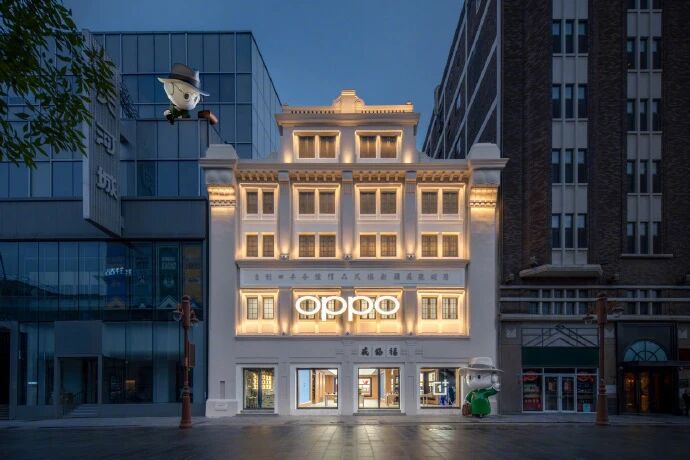
Stepping Into the Store.Upon entering, the narrative shifts. Compared to the “cold” atmosphere of most electronics brand spaces, this store has a more “human touch.” The latest products are displayed on wooden long tables, with matching sofas for relaxation beside them; above is a large LED ceiling made of carbon fiber material, integrating the century-old sense of the hat store with a modern functional expression.In collaboration with Tianjin University’s Architectural Design Institute, OPPO invited the restoration team from the Forbidden City to participate in the renovation, adhering to the “restore as original” principle to preserve the texture of the century-old building as much as possible. The store’s “Instagram-worthy” areas blend traditional Tianjin elements with modern design: local brick mixed with stainless steel bricks, colorful acrylic Taishi chairs, and the incorporation of OPPO’s logo into the ancient eaves of the building.Reviving History, Creating Community.The value of an old building is not just for “viewing” but for actively using it — that’s the beginning of restoration and revitalization. Shèng Xī Fú, known as “The Crown of China’s Hat Industry,” originally used the “front shop, back factory” model: the front was the retail counter, and the back was the hat-making workshop, where customers could see the process of making a hat from fabric to finished product.OPPO hasn’t lost this essence but has transformed it into the “front store, back community” model.
The first floor serves as the “front store,” featuring product experiences, thematic check-in areas, and a coffee zone. The second floor focuses on creating a community with areas for e-sports, photography salons, and gaming watching, allowing young people to bond with the brand while engaging in activities.This blend of historical restoration and innovation adds a soft light filter to OPPO’s brand narrative, softening the coldness typically associated with electronic products. OPPO has turned the concept of a “store” into a “space,” breaking away from the traditional understanding of flagship stores as mere “large product showrooms.” In this old building, OPPO has created a “non-standard space.”Beyond Products: OPPO’s Approach to Youth Culture.Unlike traditional retail, where the store is simply the last mile for products and customers, OPPO has turned their flagship store into a “third space” for connecting with their audience. The store integrates activities, content, and community to keep the space dynamic and relevant. OPPO is focusing on “operating user relationships” rather than merely selling products. The Tianjin flagship store becomes a “youth park” where people don’t just buy phones, they immerse in culture, interact with the brand, and create shared experiences.By understanding young people’s desire for connection and engagement, OPPO is building a strong brand-community relationship. This model contrasts with the traditional retail approach of focusing solely on selling products. Instead, OPPO emphasizes engaging with users and creating a space that resonates with youth culture, bridging history with modern innovation.