190,000 Hotpot Restaurants Exit, Is the ‘Self-Service’ Model the Lifeline?
When Haidilao’s 59.9 RMB rotating hotpot video topped the local hot search, and Cuocu’s “168 RMB All-you-can-eat Wagyu” event was fully booked for three days ahead, Zuo Ting You Yuan’s 26.8 RMB veggie self-service became the must-try “hidden gem” for diners. The self-service transformation wave swept through the hotpot industry. However, behind this transformation lies a set of harsh industry statistics: from 2024 to 2025, 165,000 new hotpot stores opened, but 192,000 stores shut down, resulting in a net decrease of 27,000 stores. In a 630 billion RMB market, the exit of 190,000 stores and the trial of self-service by some brands outline the competitive survival landscape of the hotpot industry.The “Two Extremes” of the Hotpot Industry.The “two extremes” of the hotpot industry have already become evident. On one hand, there is a store density of 3.2 stores per 10,000 people nationwide, with some business districts seeing a store on every block. On the other hand, the total number of hotpot stores is expected to shrink from over 585,000 in Q2 2024 to 539,000 in Q2 2025. In this reshuffling, 76% of closures are from independent small stores, which are suffering from the triple squeeze of rising costs, fierce competition, and changing consumer demand. Cost pressures have become a “life-or-death line”. According to research, the cost of ingredients for hotpot restaurants has increased from 38% of total costs in 2019 to 45% today, with annual price hikes for beef tallow and chili ranging from 12%-18%.
Labor costs for chain stores have also surged. More critically, there is a significant supply chain gap—chain brands rely on central kitchens to control wastage at under 5%, while single-store operations often see wastage rates exceeding 15%, which consumes most of their profits.The Shift in Consumer Spending.The shift in consumer spending is exacerbating the woes of small and mid-sized brands. Per capita spending at hotpot restaurants dropped from 80 RMB in 2023 to 77.1 RMB by the end of 2024, and 65.7% of hotpot stores now operate under 70 RMB per capita. According to the Red Meal Industry Research Institute, the percentage of consumers who plan to increase their dining expenses in 2024 has dropped from 50% in 2023 to just 31.3%, with more than half of consumers expecting to either maintain or reduce their dining spending in 2025. Intensified competition is accelerating the elimination of weaker players. Traditional hotpot types, including Sichuan, Northern, and Cantonese styles, are seeing continued decline. For example, the number of Sichuan-style hotpot restaurants has fallen from a peak of 200,000 to an estimated 168,000 by Q2 2025. The homogeneous broths and similar dish offerings have led many small stores to become “cannon fodder” in the price wars.Exploring Self-Service as a Breakthrough.As independent stores struggle through the winter, some brands have started diversifying their self-service models as a way to break through.
From high-end to semi-self-service, and from solo dining to all-day operations, these different paths reflect precise survival strategies.Cuocu: Dual-track Approach for High-End Offerings.As a mid-to-high-end brand under the Xiaobbo Group, Cuocu’s self-service transformation closely aligns with its brand positioning. From July 31 to August 31, 2025, Cuocu launched an “All-you-can-eat” self-service buffet at four locations in Shenzhen, Zhuhai, and Nanning. This maintained their high-end image while attracting foot traffic with “unlimited supply”. In September, they upgraded to a “Choose-from-menu + Unlimited Enjoyment” dual model, allowing consumers to order special dishes while selecting beef or seafood from the self-service section. This combination led to an 18% increase in table turnover rate. However, market feedback raises concerns: Xiaobbo Group’s financial report for the first half of 2024 showed a 25.8% drop in sales, indicating that whether high-end self-service can support growth remains uncertain.Zuo Ting You Yuan: Value Rebuild with Veggie Self-Service.Zuo Ting You Yuan’s veggie self-service model is a low-cost, high-value solution. The 26.8 RMB per table pricing has almost no entry barrier, yet its selection is cleverly curated. Ingredients like Rugao radishes from Nantong and winter melon from Bama in Guangxi are neatly displayed, paired with freshly sliced beef, creating a consumer perception of “quality beef + healthy vegetables”.
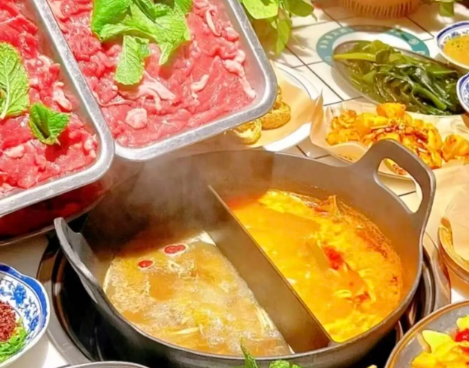
Videos shared by Douyin users confirm the success of this strategy: “More than ten kinds of fresh vegetables with the original soup base, paired with fresh-sliced beef, great value for money.” Its core product, the “Bull King Platter,” still sells over 1.1 million portions annually. This “core dish + peripheral self-service” model avoids diluting the brand’s value while precisely meeting market demand for cost-effectiveness.Haidilao: Comprehensive “Ecological Layout” with Self-Service.Haidilao’s self-service experiments showcase its scale advantage. The acquisition of “Jugaogao Self-Service Hotpot,” offering 59.9 RMB per person, targeted solo dining with a rotating conveyor belt and hundreds of dishes, effectively attracting younger consumers and those in lower-tier markets. This complements Haidilao’s high-end selection with a 700 RMB per customer average spend. More notably, Haidilao also ventured into all-day operations. In Beijing, over 20 locations introduced 22 RMB self-service lunch specials, and in Changsha, they combined self-service hotpot with work lunches to drive traffic and improve space efficiency. The backbone of this success lies in Haidilao’s robust supply chain: with more than 40 distribution centers and a logistics network handling over 1,000 tons daily, it can maintain profitability at a 59.9 RMB self-service price.Three Critical Challenges for Self-Service Hotpot Models.The self-service trend in the hotpot industry is not a coincidence but a response to the challenges of supply chain upgrades, shifting consumer demands, and intense competition.
At its core, the transformation is about using innovative models to solve efficiency issues.Differentiation is the Key Driver.In the context of the hotpot industry’s growth to 272,000 specialty hotpot stores, self-service has emerged as the most direct form of differentiation. As all Sichuan-style hotpot shops compete for spice levels, small hotpot brands like “Weila Small Hotpot” have differentiated themselves by offering “48 RMB free beef” through a self-service concept, opening 1,300 locations in county markets. Meanwhile, Xu Fu Beef has leveraged a combination of “self-service vegetables + affordable beef” to drive expansion by keeping the average spend at 48 RMB and targeting family gatherings.Consumer Demand for Cost-Effectiveness.Consumers have shifted their mindset from “seeking high-end products” to “carefully calculating costs,” and the self-service model fits perfectly with the “get more for less” mentality. According to Red Meal’s data, from Q2 2024 to Q2 2025, the number of small hotpot stores grew by 10%, with self-service outlets accounting for over 60%. Stores like Weila Small Hotpot and Yang Guofu’s self-service have achieved growth despite market downturns. This demand has even led to the emergence of new hotpot models, such as “marketplace hotpots,” where stores sell meat during the day and transform into self-service hotpot outlets at night. The cost per person is just 50 RMB, offering consumers an affordable and satisfying meal.Supply Chain as the Backbone.
Self-service models require more stringent cost control compared to single-portion offerings, and the leading brands’ supply chain capabilities create barriers to entry. Haidilao’s supply chain ensures that 90% of cities nationwide receive direct cold-chain deliveries within 48 hours. The “Feidian Plan” manages global direct sourcing and three-tier warehouse distribution, reducing ingredient wastage to below 3% and boosting the gross margin to 70%, far exceeding the industry’s average of 58%.The Hidden Pitfalls of the Self-Service Trend.Despite the enthusiasm for self-service, hidden risks remain. The old industry saying, “Transforming into self-service is the first step toward closure” is not without merit. The fall of “Ge Lao Guan” is a classic example. After shifting entirely to a self-service model by the end of 2023, the 123 RMB per person pricing attracted short-term traffic, but issues like declining food quality and the removal of signature fish heads from the menu led to a wave of complaints. By March 2025, the brand’s active locations had shrunk to just 49 stores. This illustrates the three critical challenges self-service models must navigate:Quality Control and Trust Crisis: “Unlimited supply” can easily degrade into “shrinking quality,” and once consumers associate self-service with cheapness, it is hard to reverse.Cost Control Battle: Self-service is essentially a “probability game” that requires balancing perceived value with food wastage control.Brand Dilution Risk: High-end brands that dive into low-price self-service risk eroding their premium image.