How Long Can Labubu Stay Popular?
Recently, the world’s most expensive Labubu was born—a first-generation collectible mint-colored Labubu was auctioned off for 1.08 million yuan, instantly causing a social media frenzy. Some netizens believe that “this is the emotional value of young people,” while others express that “the world has gone crazy.” However, this does not stop Labubu from continuing to captivate the world. Global celebrities such as Rihanna, Beckham, and Lisa are all promoting it, and Bubble Mart stores in London and Japan even had to suspend sales due to scalpers purchasing Labubu. As a result, Bubble Mart’s market value has soared. This year alone, Bubble Mart’s stock price has risen more than 170%, and founder Wang Ning has become the richest person in Henan.But as Bubble Mart surges ahead, there is a collision of emotions—frenzied fan adoration versus a sense of bewilderment. Labubu’s global fans are still rushing to snap up new releases, while onlookers believe this is simply an emotional hype. But is there really only emotional value behind Labubu?Labubu is riding the “era dividend.” Wang Ning, the founder of Bubble Mart, may not have expected such high enthusiasm for anime culture from the capital market. Looking back at Bubble Mart’s initial public offering (IPO), it was a blend of glory and controversy. In December 2020, Bubble Mart became the first trendy toy company to be listed on the Hong Kong Stock Exchange. However, after its listing, Bubble Mart’s stock price began to plummet, halving in value within just one year. The biggest controversy surrounding the company at that time was its uncertainty.
On the one hand, the revenue growth of Bubble Mart’s flagship IP “Molly” had dropped from triple digits to double digits, raising concerns about whether Bubble Mart could create the next “Molly.” On the other hand, the blind box model was not new, with no barriers to entry. As more competitors entered the market, the “surprise factor” of the blind boxes faded. More critically, the “IP + blind box” model brought high profit margins, but complaints about product quality and after-sales service persisted, leading to doubts about whether the company was exploiting consumers through “stupid tax.”Even though these pain points and doubts still exist, Bubble Mart unexpectedly found itself in sync with a consumer trend that was perfect for brand explosion—during an economic downturn, consumers became more cautious about big-ticket purchases, but small emotional consumer goods, priced around 100 yuan, thrived. Labubu’s rise came at just the right time.On one hand, Gen Z consumers crave products that offer emotional value. Bubble Mart’s “IP + blind box” model provides not only emotional companionship but also satisfies consumers’ desire for novelty and excitement through surprise, bringing emotional value to an unprecedented height. The viral effect of social media further amplifies the fusion of emotion and social interaction. This means Labubu is not just a product that satisfies individual emotional needs but also a new type of social currency. Young people build unique social circles by “buying and showing off their toys,” aligning with the current trend of weak-tie social connections.
On the other hand, from a global market perspective, cultural identity challenges different consumers across countries and cultures, and Labubu has become a symbol of emotional resonance that transcends geographical and cultural boundaries. Labubu’s creator, Hong Kong artist Long Jiasheng, once said, “I hope Labubu represents a side of young people’s hearts that is often unknown to others.” With its round face, sharp ears, nine sharp teeth, and mischievous grin, the toy strikes at the rebellious psychology of young people, reflecting their refusal to be defined and their resistance to conforming to societal norms. It has become a spiritual symbol of self-expression for them.Finally, the star effect has further amplified Labubu’s global influence. From top idols like Lisa to A-list celebrities such as Rihanna and Beckham, Labubu’s commercial momentum has been snowballing. At this point, Labubu provides more than just emotional and social value. It now also carries the “trendsetting power” conferred by celebrities and influencers. For consumers, Labubu has become a symbol of fashion in the trend-driven toy sector.Looking at Bubble Mart’s “star-making” strategy, the direct explanation for Labubu’s global success seems to be “spiritual fulfillment.” However, the trendy toy industry is not lacking in toys like Labubu—so why is it that Labubu, rather than other toys, became an explosive hit? The answer lies in the “human factor” behind the “right place and right time.”On the surface, it seems like luck has favored Labubu, but in reality, there’s a hidden “star-making” strategy crafted by Bubble Mart’s founder, Wang Ning. First, breaking the “IP mystique.”
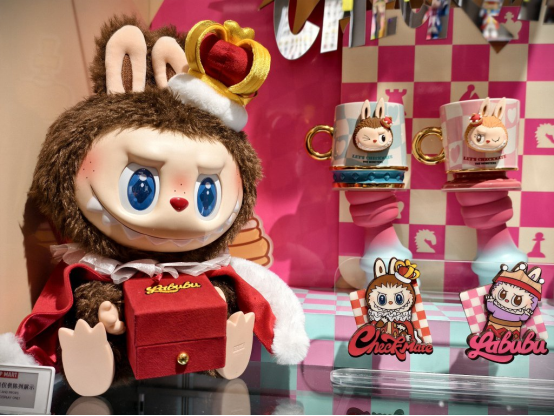
From the very beginning, the lifespan of an IP has always been a looming sword hanging over the company’s head. The sudden rise of an IP feels almost like an art of mystery, with high uncertainty. For this reason, Bubble Mart has placed a heavy emphasis on the development and operation of IPs and has built a mature and robust IP incubation and operation system. Currently, Bubble Mart maintains close relationships with more than 350 global artists and has nearly 100 IPs, 13 of which have generated over 100 million yuan in revenue. By collaborating with more artists, Bubble Mart has accumulated more possibilities, enabling it to quickly capture market trends and secure first-mover advantages when demand for a certain type of IP arises. Wang Ning once mentioned that Bubble Mart has a mature system to incubate and operate IPs, based on data and market feedback rather than personal judgment. But even so, Bubble Mart’s IP collaboration and management director, Xu Xiaobing, stated, “Trends are not mathematically derived. They can be predicted, but they are not rigorously certain.” Therefore, Bubble Mart needs to extend the lifespan of its IPs as much as possible. When Labubu became difficult to find, Wang Ning also made it clear that he would not excessively deplete its value, preferring to control the output. He believes that IP is an asset that requires careful operation, and maintaining its uniqueness and long-term value is more important than short-term profits.Secondly, Bubble Mart has its own supply chain code. Industry insiders say, “Designing an IP is not difficult; the difficult part is turning it into a finished product, which requires going through hundreds or even thousands of processes.
Many factory samples differ greatly from the expected outcome.” In recent years, Bubble Mart has continuously invested in creating a flexible supply chain, achieving a complete information chain from IP design to end-user sales, improving coordination between production and marketing. Last year, Bubble Mart’s gross margin increased from 61.3% in 2023 to 66.8%, which the company attributes to ongoing supply chain optimization.However, as Bubble Mart expands globally, it still faces challenges in optimizing its supply chain. For example, when the “Nezha” IP became a hit earlier this year, the Nezha figurines sold out, and global sales have created issues such as logistics fluctuations and data delays. Bubble Mart must prepare for global expansion, which is an unavoidable issue.Lastly, through comprehensive marketing efforts, Bubble Mart has successfully integrated its IPs into global consumers’ lifestyles. In recent years, Bubble Mart’s IPs have made frequent appearances worldwide, such as the Bubble Mart edition of “The Little Prince” exhibited at the Louvre, showcasing the company’s unique artistic design and aesthetic style. In Bangkok, the store was designed as a coffee social space, extending the consumption scenario into the lifestyle realm.There are also Bubble Mart stores in Japan, France, the UK, Italy, and the Netherlands. During its global expansion, Bubble Mart fully utilizes all available resources for cross-promotion. For example, a month before the opening of its first store in Thailand, Bubble Mart rented 11 large screens in a shopping center for advertisements. It also invites influencers to create content and interact with fans, forming a series of short video marketing campaigns to ensure store popularity.
Today, Bubble Mart is transitioning from “virtual to reality,” transforming its IP into a sustainable cultural trend and exporting it to global markets, aiming to capture consumers’ early mindshare.As for capital, is it “bubble” or “boost”? Indeed, Bubble Mart’s success is not only due to “timing and location” but also its own “star-making strategy.” However, the real question lies in whether this model’s barriers will support its trillion-yuan valuation. By the end of Q1 2025, over 200 funds held Bubble Mart’s shares, reflecting the company’s almost unparalleled operational performance. In 2024, Bubble Mart’s total revenue is expected to be nearly 17 billion yuan, while its competitors TOP TOY and 52TOYS will generate 980 million yuan and 630 million yuan, respectively. Given this, the secondary market naturally chose to invest in Bubble Mart, contributing to its soaring stock price. However, with the stock price rising further and the founder Wang Ning’s capital partner, Fengqiao Capital, liquidating its holdings at a high price, there are concerns about a valuation bubble in the market.Wang Ning, however, seems unconcerned. During a recent earnings call, he was asked about the ups and downs of the company’s valuation and responded, “Every company will go through cycles and winters. The company will prove its value through its actions.” Previously, Bubble Mart’s stock price went through a surge, plummet, and rebound, and Wang Ning expressed, “I try not to look at stock prices, and I require the management team to do the same, so stock prices do not affect our long-term decisions and short-term management.”No one can always ride the wave of success. Wang Ning understands this, which is why he focuses on