Walmart China in Transformation: How They Have Changed Their Stores
With the rise of the new middle class, the concept of “New Retail” was proposed in 2016, and e-commerce giants began expanding offline. Despite being the world’s top-ranked Fortune 500 company for 10 consecutive years, Walmart has faced unprecedented competitive pressures in China. Surrounded by e-commerce and offline competitors, Walmart China’s two main business formats—hypermarkets and Sam’s Club—have experienced opposite situations. While Sam’s Club has accelerated its store openings, expanding and defending at the same time, the hypermarkets have opted for contraction while also undergoing transformation and upgrading.Recently, Walmart China announced the completion of the first batch of upgrades for 29 hypermarket stores across 8 cities nationwide. These upgrades mainly focus on differentiating the offline product offerings and customer experience, as well as transforming stores into omni-channel retail infrastructures.Shifting Consumer Focus from Price to Value.Low prices have become the dominant theme in fast-moving consumer goods retail. However, e-commerce has a natural advantage in cost structure over offline stores. If offline retailers do not create clear differentiation in products and customer experience compared to online platforms, the inevitable result will be further market share compression. Walmart’s differentiation in products and experience manifests in several aspects:Customization.
In recent years, Walmart has increased its collaboration with suppliers, co-developing many differentiated products. For example, at Walmart’s Xuanwu store in Beijing: the “New Year’s Goods Street” entrance features over 700 items, with 60% being new products, nearly half of which are customized by Walmart. In the “quick-cooking” category, Walmart partnered with 24 restaurant chains and 29 brands to create five major series: “Chef’s Home Feast,” “Chef’s Dishes,” “Chef’s Delicacies,” “Chef’s Midnight Snack,” and “Chef’s New Year Gift Voucher,” catering to various scenarios.For non-food items, Walmart sources globally and directly connects with manufacturers. For example, in the daily personal care category, Walmart combined the popular trend of essential oils with the “formula” trend, collaborating with the world’s top three fragrance companies to select European fragrance formulas and Atlantic cedar essential oil, creating an exclusive brand: Mefree Essential Oil Scented Care Series.Packaging Visualization and Standardization.Walmart’s custom-branded products focus on packaging that “speaks for itself.” For example, with ready-to-eat meals, customers can clearly see the flavor, serving size, cooking methods, and other information right on the packaging, making the product’s uniqueness and display powerful enough to “communicate” with customers from a distance. Additionally, using square packaging maximizes logistics space and reduces loss, optimizing supply chain costs.”
Five Senses” Experience Upgrade.Unlike e-commerce, where products can only be viewed through a screen, offline stores offer a full sensory experience—sight, sound, smell, taste, and touch. To enhance this experience, Walmart has introduced live cooking, tasting stations, and other interactive displays, allowing customers to fully experience the product before making a purchase. Walmart’s Chief Purchasing Officer, Zhu Jun, explained that as Walmart expands its product categories, it also minimizes redundant SKUs within the same category, ensuring a rich yet non-repetitive selection. For instance, the number of products at Walmart’s Xuanwu store was reduced by 50% compared to before the upgrade, giving each product more display space. Walmart also presents products in a “X9.9” pricing format and offers cross-category promotions, such as “3 items for 9% off,” keeping prices consumer-friendly.Zhu Jun stated, “As the retail industry evolves, consumer habits are becoming more ‘refined.’ Refined means being smart, concise, and also sophisticated. Only constantly evolving retailers and products can meet the expectations of evolving consumers. Walmart has always had a strong focus on people’s livelihoods, and we are undergoing major product reforms to help customers buy better products at lower prices and offer them an upgraded experience from ‘saving’ to ‘refining.'”
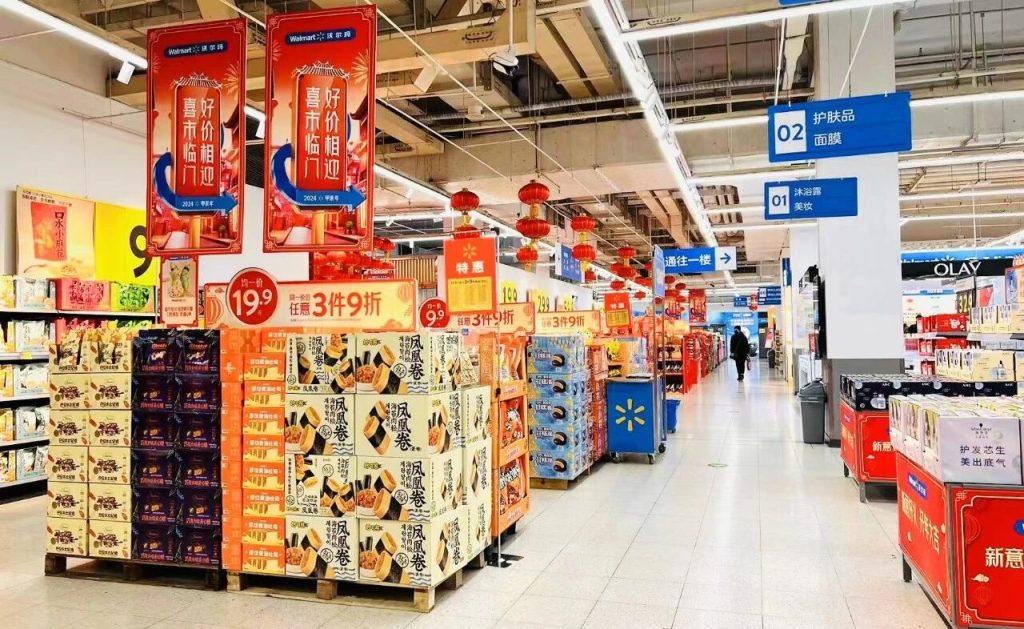
Omni-Channel Model Centered Around Stores.Walmart has established a complete omni-channel retail matrix that includes near-field, mid-field, and far-field distribution ranges with varying delivery times.Therefore, Walmart’s offline stores are not only shopping destinations but also fulfillment centers for instant retail and showcases for e-commerce.Zhu Jun revealed that e-commerce sales at Walmart’s hypermarkets in China now account for nearly half of total sales and are growing at a profitable and sustainable pace. However, Walmart does not focus on e-commerce share but aims to offer an exceptional shopping experience both online and offline, allowing customers to choose freely. Walmart has also entered popular social media platforms like Douyin, Xiaohongshu, Kuaishou, and WeChat Channels, establishing a content marketing matrix to push online products. For example, during the New Year’s festival peak, Walmart launched a #WalmartNewYear campaign with celebrities like Hu Ke and Tian Liang to amplify their brand presence and strengthen communication with local communities, creating a festive atmosphere.Live-streaming e-commerce is another key focus of Walmart’s upgraded stores. Currently, Walmart has set up 39 live-streaming studios in main stores across 39 cities, with live-streams conducted in real stores, providing a real-time and authentic shopping experience. Unlike other platforms with 3-5 day delivery times, Walmart’s live-streams focus on 1-hour delivery, emphasizing a “see it, get it” approach.
Walmart has also introduced global purchasing sections in stores, allowing customers to shop for “duty-free” items in a physical setting, scan a QR code, and place orders. For example, Walmart’s Xuanwu store has introduced luxury brands like cosmetics, fine wines, and exclusive Chinese New Year-themed Lego sets, along with limited-edition red gift boxes for health products and skincare during the Spring Festival.Intensifying Industry Homogenization and Competition.Despite a reduction in the number of Walmart’s hypermarket stores, the company’s performance has improved in terms of sales and efficiency since Zhu Xiaojing became the head of Walmart China in May 2020. This growth has largely come from the strong expansion of Sam’s Club and e-commerce. However, the supermarket industry’s overall transformation remains severely homogenized. Customizing products, personalizing packaging and displays, enhancing interactivity, upgrading in-store experiences, and integrating online and offline retail are all trends Walmart shares with major players like Yonghui Superstores, RT-Mart, and Hema. Notably, Sam’s Club serves as both a benchmark for Walmart’s transformation and an area being closely watched by its competitors.As Walmart China’s president and CEO Zhu Xiaojing stated, “The Chinese market has huge vitality and potential. To win consumers’ trust, retailers must focus on offering meaningful differentiation. Many core models, such as one-stop shopping and physical stores, have not truly become obsolete; they just need to evolve and be redefined, transforming into a curated, omni-channel shopping experience tailored to target consumers.”