Self-Driving Without Passengers: How This Company Quietly Became the Global Leader on the Streets
What Are We Really Talking About When We Talk About Self-Driving?When we talk about self-driving, are we imagining futuristic vehicles from sci-fi movies or distant, far-off predictions from tech news? While the industry has long been chasing the dream of passenger-carrying autonomous vehicles, a Chinese company called Autowise.ai chose a different path: bringing cutting-edge technology down to the streets.The company not only received the world’s first autonomous street sweeper test license and China’s first permit for unmanned sanitation equipment on public roads, but it has also expanded its operations to over 30 cities worldwide, ranking first globally in the commercial unmanned sanitation market.This all began with a critical, “grounded” transformation by Autowise.ai’s founder and CEO, Huang Chao.From R&D Engineer to Entrepreneur.At the 2025 Fortune 40 Under 40 Innovation Lunch, Huang shared his journey. Previously an engineer at Baidu and Didi, his initial entrepreneurial path was like many others: building one of China’s first Robotaxi fleets and pursuing the dream of passenger-carrying autonomous vehicles.In 2017, after leaving his job, Huang, at the encouragement of friends, “blundered into” entrepreneurship, initially focusing on the passenger-carrying autonomous driving track. He soon realized the market was saturated with giants, and the commercialization cycle was far longer than expected.A friend suggested starting his own company, promising help with financing. “Only after establishing the company did I realize that technology without a business model is just a castle in the air,” Huang admitted.
After founding the company, reality posed a stark question: where is the actual commercial value?Pivoting to Street Cleaning in 2019.The turning point came in 2019. Huang’s team discovered that the traditional sanitation industry faced labor shortages, high costs, and significant risks. Applying AI and autonomous driving to such challenging environments could truly replace human labor or fill workforce gaps.Switching from passenger transport to sanitation seemed like a huge leap, but in reality, it was a precise alignment of technology with the right scenario. Sanitation work is low-speed, high-frequency, and relatively controlled, lowering the barriers for autonomous driving deployment.Challenges were significant: in 2019, unmanned cleaning equipment cost over three times more than traditional machinery. “We knew the direction was right, but reducing costs became a matter of survival,” Huang recalled. Over three years, the team iterated three generations of products, optimizing everything from sensor selection to algorithms, even testing brush materials repeatedly.By 2022, Autowise.ai’s self-produced autonomous street sweepers achieved operating costs lower than traditional methods. “Only then did I feel that this path was viable,” Huang said.Building the “Iron Triangle” in the Real World.For a startup, technological insight is just the first step. Turning lab algorithms into products that work reliably in the real world is a challenge for all tech companies.Autowise.ai’s commercial success rests on an “Iron Triangle” of three self-developed core products:Autowise V3 — autonomous street sweeper.
Autowise V1 — over one year of operational experience.Roboard-X — multi-scenario autonomous driving platform.Technology is the company’s “brain”, while the Autowise V3 is its “body” — the first full-stack, self-developed, mass-delivered autonomous sweeper.The V3 weighs under 3 tons, allowing it to operate as a special vehicle while avoiding stricter commercial vehicle licensing. Yet its cleaning performance matches traditional 5-ton models, with comparable brush power, water tank, and vacuum capabilities. Its compact size and maneuverability—width just 1,490mm, adjustable cleaning width 1,200–2,400mm, minimum turning radius 3,325mm—allow operation on narrow pathways, pedestrian zones, and urban streets.The V3 became the industry disruptor, winning China’s first public road permit for unmanned sanitation equipment.Autowise V1: Multi-Function & Cost-Effective.Autowise V1 addresses usability and cost-efficiency, featuring an autonomous chassis with interchangeable modules. One chassis can become:Autowise Sweeper — street cleaning.Autowise Sprinkler — dust control.Autowise Transfer — waste transport.This “one vehicle, multiple functions” design maximizes utilization, reducing customer costs by up to 70% and lowering capital and space requirements.The system is fully unmanned, capable of scheduled tasks, automatic charging/refilling, and autonomous garbage disposal—all without human intervention.
Roboard-X: Expanding the Ecosystem.Roboard-X is a highly open autonomous driving platform, supporting multiple interchangeable modules for cross-scenario deployment:Roboard Space — passenger shuttles.Roboard Van — freight logistics.Roboard Sweeper — street cleaning.Clients receive 3D data of the chassis for custom module design and can access high-level APIs for secondary development, transitioning Autowise.ai from a sanitation equipment supplier to an autonomous driving platform provider and ecosystem builder.Performance-wise, Roboard-X employs dual Orin automotive-grade computing units (600 TOPS, redundant), supports L4 commercial standards, speeds up to 40 km/h, 20° climb, and redundant four-wheel braking with <200ms response time—ensuring reliability in all commercial scenarios.“Light Service” Business Model.Autowise.ai introduced a “light service” model: instead of selling expensive equipment, partners pay an operational service fee, gaining access to Autowise’s technology and operational expertise.This lowers entry barriers, reduces risk, and ensures faster adoption while creating healthy cash flow, stronger customer retention, and a competitive moat for Autowise.ai.Global Deployment: From China to the Middle East.Domestically, Autowise.ai uses a pragmatic rollout strategy, starting in Shenzhen’s Nanshan Qianhai: over 10 vehicles operate daily 6.5 hours, covering major roads, pedestrian areas, and commercial centers with human-vehicle and vehicle-vehicle collaboration.
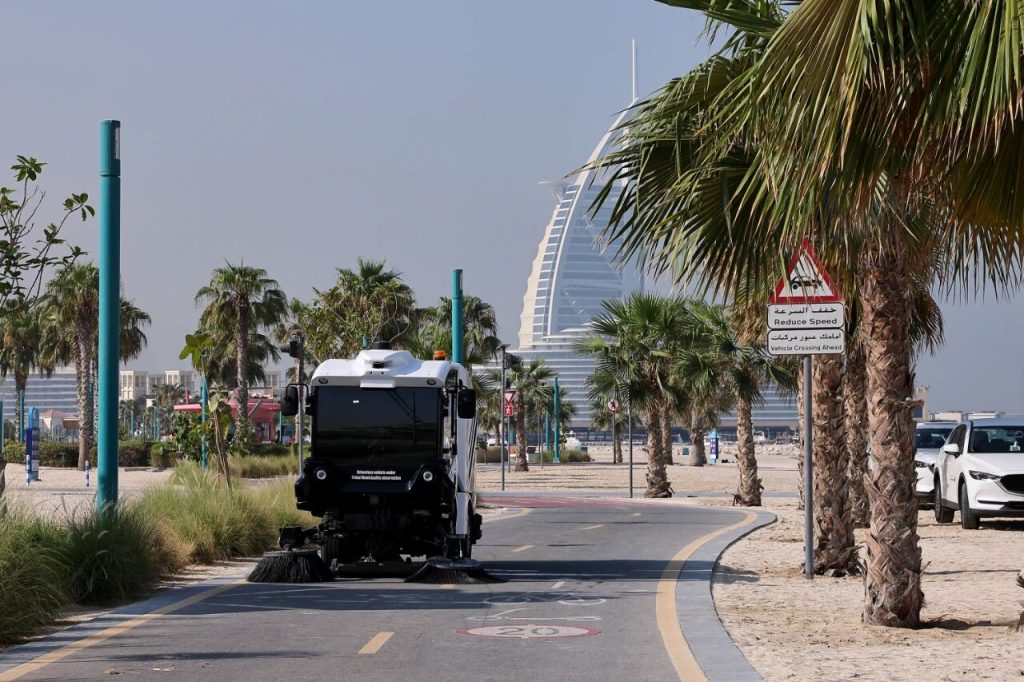
In Hubei’s Jingshan, the company manages 3.14 million m² of city roads, pioneering the “platform + equipment + service” smart sanitation model, covering vehicle dispatch, route planning, autonomous cleaning, and charging/refilling.Internationally, in 2023, Autowise.ai partnered with Ajlan Brothers Holding Group in Saudi Arabia to deploy 1,000 autonomous vehicles, addressing extreme heat and sandstorm challenges, high local labor costs, and strong government interest in economic transformation.In Dubai, vehicles operate on Jumeirah Beach bike paths, navigating crowded, curved pathways while avoiding pedestrians—earning recognition from municipal authorities.In the UK, vehicles support SPAR’s James Hall logistics hub in Preston, handling high throughput, busy truck traffic, fog, and rain while performing edge cleaning and unloading zone sweeps.Commercial Value: The Key to Survival.Autowise.ai’s journey mirrors the ups and downs of China’s tech startup capital cycles. Huang emphasizes the importance of grounded, business-focused decisions over tech hype. The company’s strategy during capital “cold winters” strengthened cost control and the light service model, allowing sustainable growth.Autowise.ai now operates in 30+ cities globally, with 13 million+ km cumulative mileage, holding the first global autonomous street sweeper test license and China’s first public road permit for unmanned sanitation equipment.And it all started with a simple mission: to help sanitation workers avoid cold, heat, and danger, while creating new productivity and value for society.