Urban Mega-Venues: How to Prevent Them from Becoming ‘Sleeping Giants’?
The heat of the 15th National Games shows no sign of fading, once again drawing the nation’s attention to major sporting events. Unlike many previous large-scale competitions, the 15th National Games did not construct any new mega-venues; over 90% of the venues were upgraded or renovated. This approach is pioneering and also brings to mind the perennial challenge of “post-event operations” for large-scale venues.Some venues remain lively even after the games, while others gradually fall into disuse and fade from public attention, becoming part of the “big city problem”—transforming from iconic landmarks into “sleeping burdens.” With investments often reaching billions, and after sharing the same moments of glory and spotlight, why do some venues flourish while others languish? How can they escape the fate of “glory during the games, desolation afterward”? This remains a key topic in discussions on sustainable urban development. Today, we explore how urban mega-venues can maintain vitality through a full-cycle operational perspective.Proactive Operations: Designing for the Venue’s “Second Life”.Traditional infrastructure logic is typically linear: “build-use-maintain.” But for mega-venues, planning cannot end at the construction stage; the design must anticipate how the venue will generate revenue and be utilized over decades. This principle—operations driving design—ensures that foresight is embedded into the venue’s lifecycle from the start.
For instance, in the 15th National Games, a clear signal emerged: the guiding principle for venue use was “minimal renovation, maximal sustainability.” CR Land, responsible for upgrading core venues in Shenzhen, managed three competition zones and seven venues. Even in the details, one can sense the calm expertise of a team prepared for a major test.The Shenzhen Bay Sports Center implemented a “smart brain”—an integrated energy and carbon management platform. It automatically monitors crowd flow, equipment anomalies, and energy consumption using AI algorithms, replacing manual oversight. Acting like a shrewd house manager, the system allows the venue to operate efficiently and low-carbon even when not hosting events. In essence, intelligent management, immersive spectator experiences, and pursuit of operational excellence define the baseline for a venue’s long-term content capacity.Another example is the newly built Chengdu Dong’an Lake Sports Park, the main venue of the 31st Summer Universiade. Its design philosophy, “highly integrated and flexible for both competitions and everyday use,” utilizes roof structures for operational functions. Within a 29.17-meter-high steel truss, a 300-meter-long panoramic observation hall was built. Post-event, this “time-space corridor” can host diverse functions and showcase Chengdu’s park-city development.
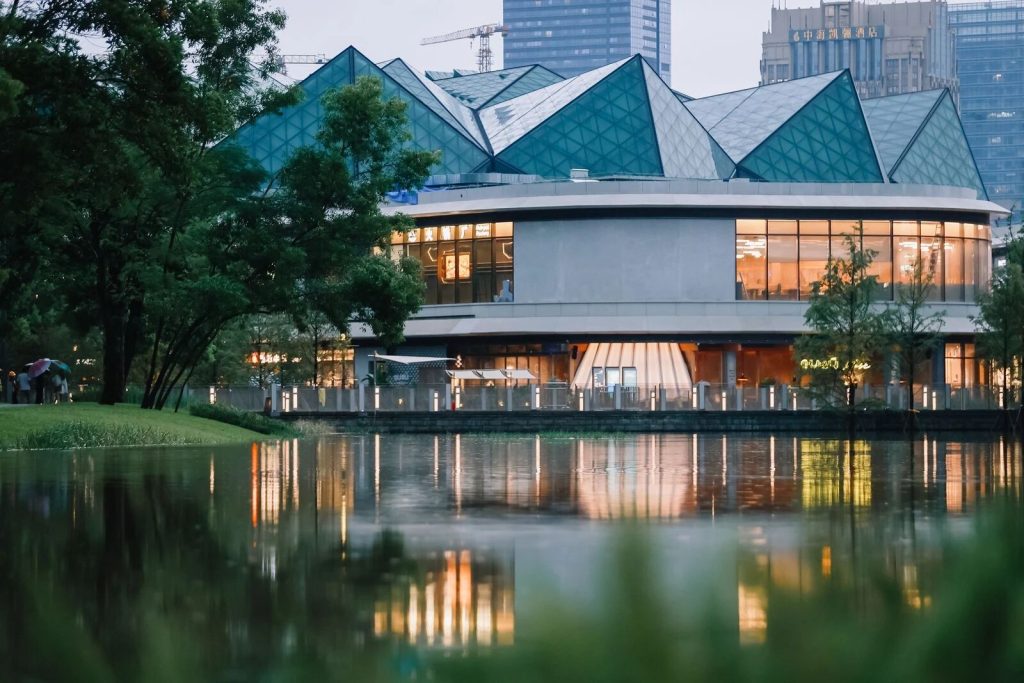
Additionally, venues are designed for adaptability: swimming spectator stands can expand, gymnasiums can switch between ice and basketball configurations, and event modes can seamlessly transition between competitions and performances. This forward-looking approach equips the venue with the flexibility to handle uncertainty, embedding sustainability into the design from day one.During the 15th National Games, CR Land’s involvement in multiple venues reflected a commitment to the “Green Games” initiative and prioritized post-event public use. By integrating operations from the outset, these venues become “living assets” that are usable, manageable, and economically sustainable, rather than dormant architectural relics waiting for rescue.Operational Breakthroughs: “Competition + Performance + Commerce” Model.If hardware sets the venue’s lower bound, long-term operations determine the upper bound. Sustained operations answer the critical question: when the crowds leave, how does the space continue generating value?CR Land’s “competition + performance + commerce” model transforms venues from single-function “containers” into multi-purpose “generators”:Competitions as the Core: Professional events maintain momentum. Leveraging international experience, CR Land has cultivated high-profile IP events, such as the Shenzhen Nanshan Half Marathon—recognized as China’s most “tech-savvy” race, now one of the country’s most influential half-marathons.
The Tianwang Cup International Badminton Open, with a total prize pool of 2.4 million RMB, attracted over 20,000 attendees in person and millions online, achieving global exposure. These events are not just about professional content—they sustain venue vibrancy and industry stature.Performance Activation: Entertainment programming drives foot traffic. The Shenzhen Bay Sports Center, a 2011 Universiade venue, has become a hub for mass fitness, international sports competitions, and major concerts. Continuous content supply has kept the “Spring Cocoon” venue lively; in 2024, it hosted over 1,000 sports and commercial events, serving more than 10 million visitors.Commercial Empowerment: Maximizing space value beyond events. The Shenzhen Bay Sports Center offers youth sports training programs in swimming, tennis, and badminton; public fitness zones allow everyday exercise in a championship venue; retail spaces maintain a 95%+ occupancy rate, including dining and leisure. This approach converts “off-peak” times into “consumer activity,” transforming venues from competition sites into lifestyle destinations. Data confirms success: the Sports Center became profitable within a year post-Universiade, generating revenue exceeding 100 million RMB, breaking the myth that mega-venues survive only on subsidies.Urban Integration: Venues as the “Pacemakers” of City Life.A single venue’s vitality is limited; real breakthroughs occur when venues are woven into the urban fabric and district dynamics.
CR Land’s integrated operations model connects venues with surrounding commercial and public amenities:Traffic Conversion: Spectators become consumers. At the Longgang National Games Center, concerts drive nearby restaurants and businesses, creating a closed loop of performance + consumption. This builds a sustainable “traffic-to-economy” cycle.Functional Synergy: Seamless spatial integration. Underground corridors and skywalks link venues with shopping complexes and parks, allowing audiences to transition effortlessly from watching events to dining, shopping, and leisure—facilitating “multiple experiences in a single visit.”Ecological Connection: From landmark to everyday life. Public spaces now serve as urban living rooms for recreation, socializing, and fitness. Venues can even convert into emergency shelters, as during Typhoon “Huajia Sha,” accommodating nearly 2,000 residents.Mega-venues are complex, large-scale, and interconnected; if neglected, they risk becoming architectural liabilities. Sustainable operation may appear slow, but it is essential for maintaining urban resources and quality of life. Long-term success requires breaking short-sighted political or business logic, embedding flexibility in design, activating space potential through operations, and integrating venues into city life.Ultimately, a successful venue is not measured by the number of events it hosts but by how deeply it embeds into the city post-event. When architecture supports urban services, fosters citizen well-being, and balances peak usage with daily life, it embodies the ideal of a sustainable, living mega-venue—inviting us to rethink how we perceive urban spaces.