Longfor Huanxi: How ‘Space Folding’ Captures the Attention of Young People
When Shopping is No Longer the Sole Purpose of Consumers Entering Malls, Modern Commerce Begins to Embrace “Space Folding”.Shibuya Miyashita Park, leveraging the attraction of its rooftop public green spaces for urban crowds, cleverly sets up bridges that connect to both the street and the mall. This creates accessibility between different floors of the park, mall, hotel, and other buildings. At the same time, the boundaries between different project areas are blurred—malls can utilize public spaces to create outdoor leisure areas, while hotel residents can consider the park and commercial areas below as part of their amenities. Unlike the traditional “self-contained” approach between different functions, this method not only connects commercial spaces with public areas, but also supports the growing and diverse needs for leisure, living, and office environments. This approach also challenges teams to efficiently layout spaces within limited areas and integrate content in a way that is both high-quality and well-coordinated.As “space folding” becomes the standard in large city commercial developments, how will domestic projects innovate? Longfor’s latest innovation is here. At its core, space folding is a dynamic integration method designed to meet the growing density of consumer demands. Unlike traditional functional layering, today’s younger generation, as the main consumer group, is more inclined to prioritize both scene fluidity and emotional freedom when choosing commercial spaces to visit—this has become one of the main reasons why non-standard commercial spaces are so popular.
By taking advantage of open-plan street block spaces, these projects respond to the younger generation’s desire for multicultural experiences through the fusion of attributes like pet-friendly areas, sports, and leisure activities. Additionally, they provide a fluidity of content that enriches emotional layers, allowing the space to meet young people’s social needs while also offering the emotional freedom to disconnect whenever they wish. This “dual co-creation” model introduces a new definition of space folding in domestic commercial projects—reducing the “designed” feeling of commercial spaces in consumers’ experiences, and instead focusing on creating a space that satisfies both behavioral and emotional needs from the perspective of young people.Based on this logic, Longfor has introduced the “Huanxi” product line to bring innovative solutions to the market. Under the new planning concept of “Hybrid Space,” this innovative product integrates vibrant street blocks with high-quality apartments, office buildings, and elderly care services, allowing for a seamless combination of accommodation, dining, lifestyle services, leisure, and social functions. The Huanxi project is operated under Longfor’s asset management brand “Longzhi Asset Management,” which leads the operations. Even before the product line was officially revealed, Huanxi had already attracted significant attention due to its association with the trusted “Longfor” brand.
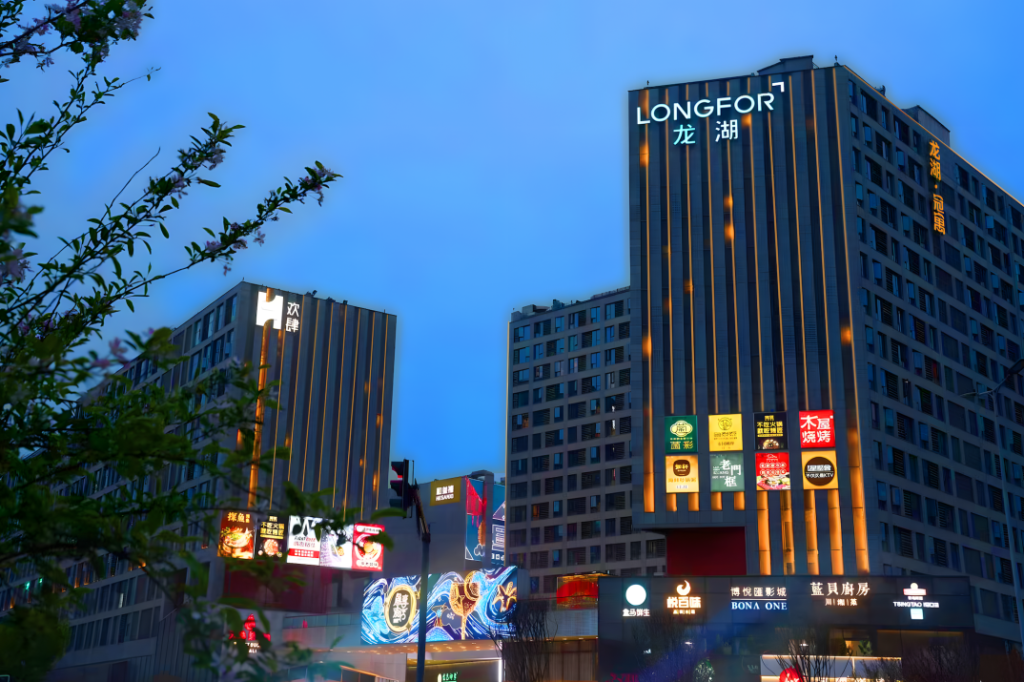
However, unlike more established mid-to-large scale product lines like Tianjie and Xingyuehui, Huanxi focuses on how to meet the lifestyle needs of young people within limited offline space. Therefore, the project size is usually controlled between 30,000 to 80,000 square meters, with 20,000 to 30,000 square meters of high-quality apartments combined with 10,000 to 30,000 square meters of mixed commercial street blocks. The project intentionally reduces the emphasis on purpose-driven consumption, focusing instead on creating relaxed and socially-friendly living environments.Thanks to Longzhi Asset Management’s experience across various business sectors such as long-term rentals, commercial real estate, industrial office spaces, and elderly care, it cleverly integrates the “Guan Yu” long-term rental apartments—targeted at urban youth living needs—with the Huanxi concept. Currently, Guan Yu has over 300 open stores and manages more than 160,000 units. After integrating, the young tenants of Guan Yu serve as the “foundation” for commercial consumption, forming the base for frequent consumer activities at Huanxi.Huanxi can also leverage the existing database of its tenants to predict demand patterns and further create commercial touchpoints that promote consumption among young customers while expanding cultural engagement. In this way, not only can asset returns and value be increased through space integration, but a differentiated “eco-circular” flow can be cultivated within the project, blending residential, commercial, and social functions seamlessly.